7 Steps to Evaluate Research Peptide Batch Consistency
Last Updated: November 5, 2026
Quick Summary
Evaluating peptide batch consistency means comparing analytical results across production lots to confirm that purity, identity, and impurity profiles stay within defined limits. A single purity value proves very little on its own; consistency across lots is what makes a reagent reliable, so results from one lot can be compared against the next without reworking the method.
- A COA listing a different lot number than the vial invalidates the comparison before it begins.
- Acceptance criteria should distinguish critical attributes like identity and main-peak purity from informational ones.
- Two lots can report the same headline purity while differing in impurity pattern.
- A sample can be highly pure and still be the wrong peptide, so identity testing closes that gap.
- A single pair of lots cannot establish consistency; consistency is a property of a series.
Table of Contents
- Why Peptide Batch Consistency Matters in Research
- Building a Peptide Quality Control Checklist
- What a Peptide Certificate of Analysis Should Include
- Peptide Batch Testing Procedures: Purity, Identity, and Impurity Profile
- Peptide Batch Traceability: Lot Numbers and Manufacturing Records
- A Repeatable Cross-Lot Comparison Workflow
- Independent Verification and Laboratory Selection
- Requesting Batch-Specific Documentation from APEX 100 RESEARCH
- Frequently Asked Questions
Why Peptide Batch Consistency Matters in Research
Evaluating research peptide batch consistency is the practice of comparing analytical results across production lots to confirm that purity, identity, and impurity profiles stay within defined limits.
That distinction matters more than most sourcing guides admit. A 2025 review of regulatory guidelines for therapeutic peptide analysis describes analytical characterization, stability testing, and quality control as separate, ongoing obligations rather than one-time certificates.
This guide sets out a repeatable set of steps, so results from one lot can be compared against the next without reworking the method.
Building a Peptide Quality Control Checklist
A peptide quality control checklist is a written set of inspection, documentation, and acceptance requirements applied to every incoming lot, turning a subjective impression into a recorded decision.
The checklist should cover what arrives, what paperwork accompanies it, and what the laboratory does with it; without one, receiving decisions drift between staff and shipments.
Incoming Inspection and Documentation Review
Incoming inspection starts before any vial is opened. The shipment is checked against the purchase order, then the lot number on each label is matched to the lot number on the accompanying documentation.
A common mistake is accepting a COA that lists a different lot number than the vial. That single mismatch invalidates the comparison before it begins.
Acceptance Criteria and Measurement Uncertainty
Acceptance criteria are the limits a lot must meet to enter inventory; measurement uncertainty is the range within which a reported analytical value sits.
The practical sequence is:
- Define the attribute to be controlled, for example, main-peak purity by a named HPLC method, mass accuracy by a named mass spectrometry method, or appearance and solubility on reconstitution.
- State the method alongside the limit, because a limit without a method is not enforceable.
- Estimate the method’s variability from replicate measurements, ideally including a control sample run alongside each batch.
- Set the acceptance limit with that variability in mind, so that a result near the limit is interpreted against the uncertainty rather than as a hard pass or fail.
- Record the decision and the reasoning, so the same judgment can be applied to the next lot.
Measurement uncertainty is reported by laboratories for exactly this reason.
A second gap most guides miss: acceptance criteria should distinguish critical attributes from informational ones.
The evidence base for any specific numeric tolerance is thin and context-dependent, and the literature describes fit-for-purpose limits rather than universal thresholds.
What a Peptide Certificate of Analysis Should Include
A peptide Certificate of Analysis is a lot-specific document reporting the analytical results for that batch, including the methods used and the identity of the testing laboratory, not a marketing sheet.
A useful COA carries the following:
- Supplier name and the specific lot number
- Date of manufacture or synthesis
- Description and quantity of material
What most guides miss is that a COA without a lot number is not lot-specific at all. It may describe a representative batch rather than the material in hand.
Researchers who want to see how these documents are structured in practice can review batch-specific COAs and compare them against the checklist above.
Peptide Batch Testing Procedures: Purity, Identity, and Impurity Profile
Peptide batch testing procedures combine separation-based purity measurement, mass-based identity confirmation, and impurity profiling. Each answers a different question, and no single test substitutes for the others.
HPLC Purity and Impurity Profiling
HPLC separates the components of a sample and reports the relative area of the main peak against impurities, usually expressed as a percentage of total peak area.
Impurity profiling goes further, examining where minor peaks sit and what they likely represent, such as truncated sequences or oxidation products. Two lots can report the same headline purity while differing in impurity pattern.
A single purity figure cannot establish overall quality, a common caution in research-peptide quality guidance. For interpretation and common pitfalls, understanding HPLC purity results covers the values, and reading a peptide HPLC chromatogram walks through the trace step by step.
Mass Spectrometry and Identity Verification
Mass spectrometry confirms that the measured molecular mass matches the expected mass for the intended sequence, peptide identity verification, separate from purity.
A sample can be highly pure and still be the wrong peptide. Identity testing closes that gap. Researchers who need a fuller method description can confirm peptide molecular identity in the lab for a step-by-step account.
Peptide Batch Traceability: Lot Numbers and Manufacturing Records
Peptide batch traceability is the ability to follow a lot from synthesis through purification, testing, and delivery using linked records, what allows a result to be checked months later.
Traceability depends on consistent identifiers. A lot number should appear identically on the label, the COA, the packing list, and the internal record.
Retain samples matter here. Holding a portion of each lot allows later retesting if a question arises about degradation or a disputed result.
| Record | Purpose | Minimum Content |
|---|---|---|
| Lot number | Links material to documentation | Unique identifier on label and COA |
| Manufacturing record | Documents the production run | Synthesis and purification entries |
| COA | Reports lot-specific results | Purity, identity, method, lab name |
| Retain sample | Allows later retesting | Sealed portion of the same lot |
| Receiving log | Records incoming inspection | Date, condition, quantity, checker |
A Repeatable Cross-Lot Comparison Workflow
Cross-lot comparison is the step most sourcing guides skip, and the one that produces actual evidence of consistency. The workflow below is written to be repeated identically for every incoming lot, so results accumulate into a record rather than a series of disconnected certificates.
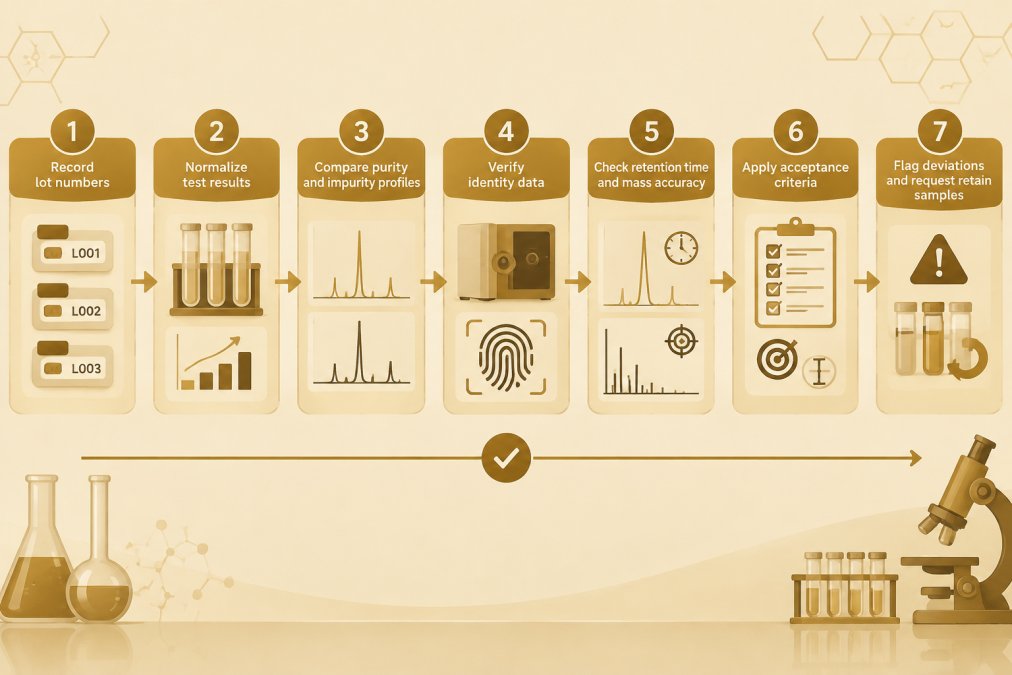
The workflow runs as follows:
- Record the lot number, test date, and testing laboratory for every lot under comparison. A comparison without a shared identifier is not a comparison.
- Normalize results so the same method, instrument class, and reporting units are being compared. Where methods differ, label the comparison as indicative only.
- Compare purity values and impurity profiles side by side, not as single headline numbers.
- Verify that identity data, typically mass spectrometry, exist for each lot and were generated on the same material that was shipped.
- Check retention time and mass accuracy against the reference standard used for that method.
- Apply written acceptance criteria, accounting for the measurement uncertainty reported with each result.
- Flag deviations and request retain samples for retesting before drawing a conclusion.
Normalization and Apples-to-Apples Comparison
Normalization is where most comparisons fail. A purity result from one HPLC method is not directly comparable to one from a different method, column chemistry, gradient, or detection wavelength; researchers describe method-dependent differences in peak integration and impurity resolution that can shift a reported purity value by several percentage points without any change in the material itself.
A practical normalization record captures, for each lot: method identifier, instrument class, column and mobile phase, detection wavelength, integration parameters, reference standard, and reporting units.
Statistical Methods for Assessing Consistency
A single pair of lots cannot establish consistency. Consistency is a property of a series, and the statistical methods used to assess it are the same ones used in analytical quality control more broadly.
Replicate measurements come first. Running the same lot more than once, and, where possible, a control sample alongside each batch, gives an estimate of within-lot variation.
Control charts are the standard tool for distinguishing routine variation from a meaningful shift.
Measures of variation complete the picture.
A Worked Comparison Table
A simple lot-comparison table makes the workflow auditable. The example below shows the structure; the values are illustrative placeholders, not measured results.
| Attribute | Lot A | Lot B | Lot C | Basis of comparison |
|---|---|---|---|---|
| Lot number | A-001 | B-002 | C-003 | Must match label and COA |
| Test date | , | , | , | Same method across lots |
| HPLC method ID | M-1 | M-1 | M-1 | Normalized to common method |
| Purity (area %) | value | value | value | Same wavelength and integration |
| Main-peak retention time | value | value | value | Against same reference standard |
| Mass error (ppm) | value | value | value | Same instrument class |
| Identity confirmed | yes/no | yes/no | yes/no | Mass spectrometry on shipped material |
| Impurity pattern notes | , | , | , | Qualitative comparison |
| Within-lot CV | value | value | value | Replicate measurements |
| Control-chart status | in/out | in/out | in/out | Limits from historical data |
| Disposition | accept/flag | accept/flag | accept/flag | Written criteria applied |
Watch out: a table filled in from COA summaries alone can look complete while hiding method differences, the normalization and replicate columns are what make the comparison meaningful.
The evidence base for any single acceptance limit is often thin, and researchers describe fit-for-purpose tolerances as a judgment call rather than a universal constant.
Independent Verification and Laboratory Selection
Independent verification means the testing laboratory has no financial stake in the result. Selecting that laboratory is a separate decision from selecting the supplier.
Questions worth asking of any testing lab:
- Is the laboratory independent of the supplier being tested?
- Which methods does it use, and are they documented?
- Does it report raw data or only a summary?
Researchers who want a clearer picture of what independence actually requires can read about independent third-party laboratory testing before committing to a verification route.
APEX 100 RESEARCH states that it verifies every batch through independent third-party laboratories in California and provides a batch-specific COA with each order. The catalog lists research compounds, including GLP-3 RTA and the Wolverine Blend.
Requesting Batch-Specific Documentation from APEX 100 RESEARCH
Documentation requests should be specific. Asking for “the COA” often returns a representative document.
A request should name the lot, ask for the testing laboratory, and ask whether raw chromatography and spectroscopy files are available alongside the summary.
APEX 100 RESEARCH states that each order includes a batch-specific COA. The research compound catalog lists available materials, and a reconstitution calculator is available for solution preparation.
For research use only, not only —. Not medical advice.
Frequently Asked Questions
How can researchers evaluate peptide batch consistency?
Researchers evaluate peptide batch consistency by comparing lot-specific analytical results against pre-defined acceptance criteria. The workflow includes reviewing each batch’s Certificate of Analysis, normalizing purity and impurity data, verifying identity by mass spectrometry, and checking retention times across lots. A 2025 review by Elsayed and coauthors describes analytical characterization, stability testing, and quality control as the core of this process. A single purity number is not sufficient; quality guides caution that consistency requires multiple data points, including impurity profiles and lot-specific documentation.
What should a peptide Certificate of Analysis include?
A peptide Certificate of Analysis should include the lot number, synthesis date, HPLC purity percentage with the chromatogram, mass spectrometry results confirming molecular identity, impurity profile, storage conditions, and the testing laboratory’s name. It should also state the analytical methods used and whether testing was performed by an independent third-party laboratory. A 2026 research-peptide quality guide cautions that quality cannot be judged from a single purity number, a vial photo, a label, or price alone; the COA must provide lot-specific data that can be compared across production runs.
How can researchers verify a peptide’s identity?
Researchers verify peptide identity primarily through mass spectrometry, which confirms the molecular weight matches the expected structure. HPLC retention time comparison against a reference standard provides a second identity check. The 2025 review by Elsayed and coauthors describes analytical characterization as central to identity verification. Researchers should request raw spectroscopy files, not just summary COA data, to perform independent confirmation. Identity verification should be repeated for each lot, because synthesis and purification steps can introduce lot-to-lot variation even when the sequence is unchanged.
Why should peptide batches be tested by an independent laboratory?
Independent laboratory testing reduces the risk that a supplier’s internal quality control misses or conceals batch deviations. A 2026 quality guide notes that supplier claims alone are insufficient for judging peptide quality. Third-party testing provides an external record of purity, identity, and impurity profile that researchers can compare across lots. When selecting a laboratory, researchers should confirm it uses validated analytical methods and can provide raw chromatography and spectroscopy data. The testing laboratory’s accreditation status and method validation records are part of the verification chain.
The hard part of batch consistency is not reading a single COA. It is building a record that lets one lot be compared honestly against the next, with matched methods, documented uncertainty, and retain samples available for retesting. APEX 100 RESEARCH supports that work with lot-specific COAs, independent third-party testing in California, and documented ?99% HPLC purity on every batch. Get started with APEX 100 RESEARCH and build a comparison record that holds up to scrutiny.