What Does Independent Third-Party Laboratory Testing Mean?
Last Updated: October 28, 2026
Quick Summary
Independent third-party laboratory testing means an accredited, unaffiliated facility analyzes a sample against defined specifications and issues a report without financial or operational ties to the party that produced or sold it. The laboratory holds no stake in the result, which is what separates third-party laboratory testing from a manufacturer’s own internal quality control program.
- Independent and third-party providers held 54.02% of the laboratory proficiency testing market share in 2025, per Mordor Intelligence forecasts.
- Independent labs are 70% to 80% less expensive than hospital-based facilities, according to PubMed-indexed evidence on low-cost provider determinants.
- ISO/IEC 17025 accreditation is scope-bound, so a method used on a sample must fall inside the listed scope of accreditation.
- A failed specification is a documented outcome: request a retest on the retained sample and treat the batch as out of specification until resolved.
- Effective July 8, 2026, importers must electronically file certificates of compliance for regulated consumer products, per CPSC third-party testing guidance.
Table of Contents
- What Is Independent Third-Party Laboratory Testing?
- Why Independent Testing Matters for Product Safety and Quality Evaluation
- Independent Lab Testing for Peptides: Verifying Purity and Identity
- Accreditation and Laboratory Qualifications: ISO/IEC 17025 and NVLAP
- How to Verify Independence and Manage Conflicts of Interest
- How to Read a Certificate of Analysis
- Costs, Turnaround Times, and the Factors That Drive Both
- Selecting a Testing Partner for Research Use
- Frequently Asked Questions
What Is Independent Third-Party Laboratory Testing?
Independent third-party laboratory testing is the practice of having an accredited, unaffiliated facility analyze a sample against defined specifications and issue a report without financial or operational ties to the party that produced or sold it. The structure matters: the laboratory holds no stake in the result. Independent/third-party providers held 54.02% of the laboratory proficiency testing market share in 2025, according to Mordor Intelligence’s laboratory proficiency testing forecasts, a figure that reflects how much analytical work now sits outside the manufacturing entity.
The distinction is structural rather than cosmetic. Readers who want a deeper, peptide-specific treatment of independent lab testing can consult the dedicated guide. A manufacturer’s own quality control program can be rigorous and still be internal. Third-party testing involves a separate entity analyzing the sample.
Why Independent Testing Matters for Product Safety and Quality Evaluation
Cost is one driver, and it is measurable. Independent labs are 70% to 80% less expensive than hospital-based facilities, according to PubMed-indexed evidence on low-cost provider determinants, which explains part of the volume shift toward independent facilities. Cost alone does not establish reliability, though. The stronger argument is conflict of interest: a facility paid by the seller to validate the seller’s product faces a structural incentive that accreditation and blind sample handling are designed to constrain.
Researchers describe the third-party medical laboratory market as valued at USD 13.22 billion in 2025, per LinkedIn Pulse’s analysis of third-party laboratory market drivers, with projected growth to USD 27.25 billion by 2035 at a 7.5% CAGR. Watch out: a low price with no documented accreditation scope or chain of custody is not a bargain, it is an unverifiable result.
Independent Lab Testing for Peptides: Verifying Purity and Identity
Independent lab testing for peptides rests on two separate questions: how much of the target compound is present, and whether the compound is what the label says. Purity without identity is meaningless. A sample can be 99% pure and 100% the wrong molecule.
HPLC and Mass Spectrometry in Peptide Identity Testing
High-performance liquid chromatography separates components and quantifies the main peak. Mass spectrometry establishes molecular weight and, through fragmentation, sequence information. The two are complementary: HPLC answers “how much,” MS answers “what.” Readers who want to understand the analytical methods behind purity and identity testing can go deeper in the linked guide. Researchers investigating antibody performance found that recombinant antibodies outperformed polyclonal and monoclonal formats across three tests, with only about one-third of the latter meeting performance benchmarks (Lund-Johansen study on antibody performance), a reminder that reagent format and verification method interact.
Accreditation and Laboratory Qualifications: ISO/IEC 17025 and NVLAP
ISO/IEC 17025 is the international standard specifying general requirements for the competence, impartiality, and consistent operation of testing and calibration laboratories. It is the standard against which a laboratory’s management system and technical competence are assessed, not a product certification. NVLAP (National Voluntary Laboratory Accreditation Program), administered by the National Institute of Standards and Technology (NIST), is one US accreditation body that assesses laboratories against ISO/IEC 17025 and other program-specific criteria. Other recognized US accreditation bodies operate under the same international framework, and the International Laboratory Accreditation Cooperation (ILAC) maintains mutual recognition arrangements among them.
Accreditation is scope-bound. A laboratory may be accredited for specific test methods and matrices rather than for testing in general. A certificate may list HPLC purity by UV detection for one matrix while excluding mass spectrometry confirmation, or list a method for one product class but not another. A logo on a website alone does not establish that a method used on a sample falls inside the accredited scope.
How to Verify Accreditation Scope
A practical verification sequence:
- Obtain the laboratory’s accreditation certificate and the accompanying scope of accreditation, not a summary page.
- Locate the exact test method (by standard number or method description) used on the sample in question.
- Confirm the matrix or product category is listed within that method’s scope.
- Confirm the accreditation body is recognized (NVLAP or another ILAC-signatory body) and that the certificate is current.
- Where a method is outside the accredited scope, ask whether the laboratory reports it as non-accredited work, an important distinction that should appear on the report.
What Accreditation Does and Does Not Establish
The evidence base on how often buyers actually verify scope, rather than accepting a logo, is thin; practitioner accounts commonly describe scope verification as the step most often skipped.
How to Verify Independence and Manage Conflicts of Interest
For readers who want to review actual batch records rather than described ones, batch-specific COAs with HPLC and mass spec results are published for inspection.
How to Read a Certificate of Analysis
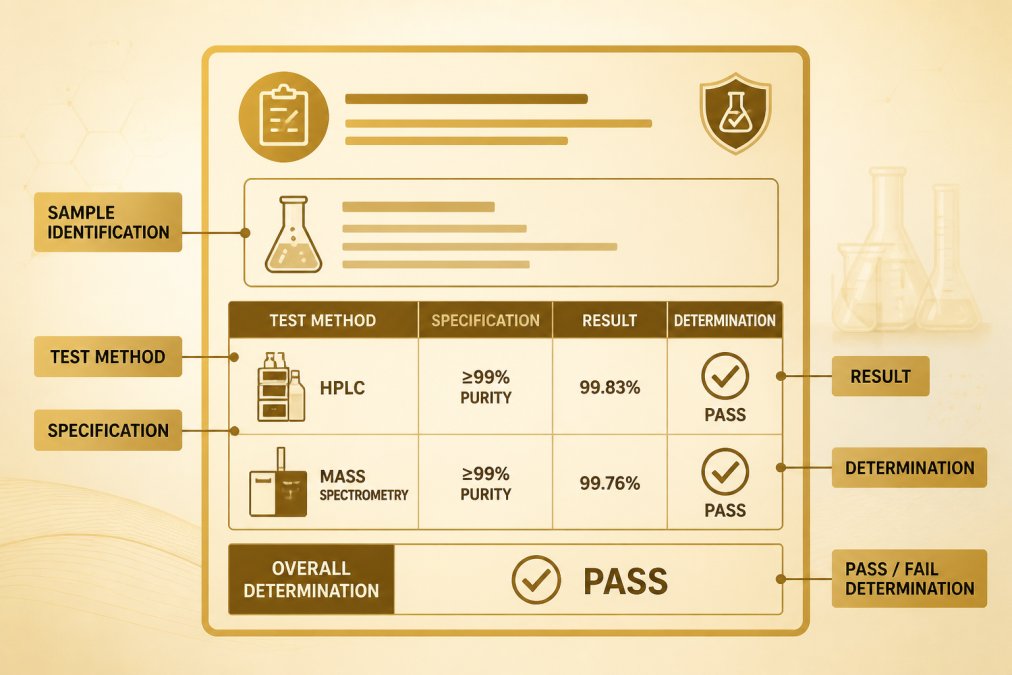
A certificate of analysis is a batch-specific document reporting information about a sample and its testing. A detailed walkthrough of each section and what the results mean is available for readers learning to interpret a COA.
Responding to a Failed Specification
A failed specification is a documented outcome, not a negotiation. The correct response is to request a retest on the retained sample, confirm whether the failure is method-related or material-related, and treat the batch as out of specification until resolved. Manufacturers that supply their own quality control materials face a known limitation here: Westgard QC (2026) notes that manufacturer-provided controls may not deliver the same independent assessment as third-party controls, since they may be optimized for the manufacturer’s own test methods.
Costs, Turnaround Times, and the Factors That Drive Both
| Factor | Effect on Cost | Effect on Turnaround |
|---|---|---|
| Number of analytes | Rises with panel size | Rises with panel size |
| Method development required | Significant increase | Multi-week addition |
| Method validation (per ISO/IEC 17025) | Adds documentation and replicate work | Extends pre-analytical phase |
| Replicate testing | Multiplies per-sample cost | Extends queue time |
| Rush processing | Premium tier | Compressed, subject to capacity |
| Confirmatory retest | Adds a second method | Adds a second cycle |
| Chain-of-custody documentation | Minor administrative addition | Minor addition |
What Actually Drives Turnaround
Turnaround is often quoted as a single number, but the realistic timeline has three phases: sample receipt and login, analytical queue, and data review and reporting. Instrument queue depth is the largest variable, a laboratory running a single HPLC system with a backlog will quote longer timelines than one with parallel capacity, even for identical methods. Confirmatory testing (for example, mass spectrometry following an HPLC purity result) adds a second analytical cycle and a second review step. Method development or validation, where the laboratory has not previously run the specific method, can add weeks before any sample is analyzed.
Regulatory Timing on the Critical Path
Regulatory deadlines can compress timelines independently of laboratory capacity. Effective July 8, 2026, importers must electronically file certificates of compliance for regulated consumer products, per the Consumer Product Safety Commission’s third-party testing guidance, which places documentation timing on the critical path. Where a compliance filing depends on a third-party test report, the laboratory’s turnaround becomes a regulatory dependency rather than a scheduling preference.
Reading a Quote
A quote that lists only a per-sample price without stating the method, the accreditation status of that method, the number of replicates, and the reporting timeline is incomplete for comparison purposes. The variables above are the ones that determine whether two quotes are actually comparable. The evidence base on published, method-specific pricing across US laboratories is limited, most pricing is quoted per project, so buyers are advised to request itemized quotes that separate analytical work, method development, and rush premiums.
Selecting a Testing Partner for Research Use
Selection criteria should be written down before any laboratory is contacted. The evidence base here is uneven: published comparisons of laboratory selection frameworks are limited, and much guidance is practitioner-derived rather than peer-reviewed. What the literature does support is that independent verification changes stewardship and financial outcomes when implemented deliberately, as described in Dark Daily’s reporting on third-party clinical decision support in hospital laboratories.
A workable checklist:
APEX 100 RESEARCH verifies every batch through independent third-party laboratories in California and provides a batch-specific Certificate of Analysis confirming ?99% HPLC purity and molecular identity.
APEX 100 RESEARCH provides US-sourced materials, independent third-party verification in California, batch-specific Certificates of Analysis confirming ?99% HPLC purity, and HPLC plus mass spectrometry testing for molecular identity.
For research use only, not only —. Not medical advice.
Frequently Asked Questions
What is the definition of an independent third-party laboratory?
An independent third-party laboratory is a testing facility separate from the manufacturer or supplier whose product it evaluates.
How does third-party testing ensure scientific reproducibility?
Reproducibility depends on documented methods, calibrated instruments, and results another lab can repeat. Third-party laboratory testing supports this by applying standardized analytical methods, such as HPLC and mass spectrometry, under an accredited quality system. A 2023 study by F. Lund-Johansen found recombinant antibodies performed better across three tests than polyclonal and monoclonal antibodies, with only about one-third of the latter meeting performance benchmarks (PMC, 2023). The lesson extends to any reagent: method choice and validation status determine whether a result holds up when another laboratory runs the same sample.
What is a Certificate of Analysis and why is it required?
A Certificate of Analysis (COA) is a batch-specific document. APEX 100 RESEARCH provides a batch-specific COA with every order to confirm ?99% HPLC purity and molecular identity.
What are the differences between internal and independent laboratory testing?
Internal testing is performed by the manufacturer’s own staff on its own equipment, which allows fast feedback but places the lab inside the commercial relationship. Independent laboratory testing is performed by an external, accredited facility with no stake in the outcome. Some quality experts argue manufacturer-provided controls may not provide the same independent assessment as third-party controls because they can be optimized for the manufacturer’s own test methods (Westgard QC, 2026). The two approaches are complementary: internal testing supports process control, while independent testing supports external verification and transparency.
How do researchers verify the accuracy of HPLC purity results?
APEX 100 RESEARCH verifies every batch through independent third-party laboratories in California, with HPLC and mass spectrometry testing for molecular identity.
How much does independent laboratory testing cost?
Pricing depends on the test method, sample count, turnaround time, and whether the lab is accredited for that specific assay. Independent labs are reported to be 70% to 80% less expensive than hospital-based facilities (PubMed, 2025), which gives a useful reference point when comparing quotes. Researchers should request a quote that itemizes method, replicates, and reporting format rather than a single lump sum. For research compounds, confirm whether the quoted price includes both HPLC purity and mass spectrometry identity testing, since the two are often priced separately.
Can a supplier’s COA be audited or verified directly with the lab?
Verification is possible when the COA names the testing laboratory and includes a lot number and method details. Researchers can then contact the named lab to confirm the report is authentic, though labs may limit disclosure without the supplier’s consent. A practical audit trail includes the raw chromatogram, spectroscopy files, and the lab’s accreditation scope. Suppliers that source materials domestically and verify every batch through named independent laboratories make this audit simpler. Ask for the lab’s name and accreditation body before relying on a COA for regulated work.