How to Verify Peptide Purity: HPLC, MS & COA
Table of Contents
- Why Peptide Purity Verification Matters for Research Accuracy
- HPLC Peptide Purity Analysis: How It Works and What It Measures
- Peptide Identity Testing by Mass Spectrometry: Confirming the Molecular Formula
- How to Read a Peptide COA: A Step-by-Step Checklist
- Peptide Batch Verification: Matching Product Labels to Analytical Results
- What Purity Results Do Not Establish: Limitations of HPLC and MS
- How to Verify Peptide Purity: A Step-by-Step Protocol
- Conclusion: Building a Reliable Verification Workflow
- Frequently Asked Questions
Last Updated: October 14, 2026
Why Peptide Purity Verification Matters for Research Accuracy
To verify peptide purity is to use analytical testing to confirm that a research compound matches its label in both identity and purity. At APEX 100 RESEARCH, we treat this as the foundation of every in-vitro study, because impurities can interfere with your data long before you notice a trend.
How much does it matter in practice? A peptide that is 85% pure means up to 15% of the vial is something else. Those other compounds can bind, block, or mimic your target. The result is data interference that no amount of careful experimental design can fix after the fact.
Verification rests on two pillars:
- Purity testing, usually by HPLC, which measures how much of the sample is your target compound
- Identity testing, usually by mass spectrometry, which confirms the compound is what the label says
The sections below walk through each method, show you how to read a certificate of analysis, and give you a step-by-step protocol you can run in your own lab.
Purity and identity are two separate questions. A sample can be 99% pure and still be the wrong peptide. You need both tests to trust a vial.
HPLC Peptide Purity Analysis: How It Works and What It Measures
HPLC peptide purity analysis separates the components of a sample and measures how much of it is your target compound. High-performance liquid chromatography (HPLC) pushes a dissolved sample through a packed column under high pressure. Different molecules travel at different speeds, so they exit the column at different times.
A detector records each molecule as it leaves the column. The result is a chromatogram: a graph with time on the horizontal axis and signal strength on the vertical axis. Each bump, or peak, represents a group of molecules.
What HPLC measures:
- The number of detectable components in the sample
- The relative amount of each component
- The retention time of each peak, which hints at identity
What it does not measure directly: the exact molecular weight. That is a job for mass spectrometry.
Reading the Chromatogram: Dominant Peak and Peak Area
The dominant peak in a chromatogram should be your target peptide. It should be symmetrical, sharp, and clearly taller than everything around it. A lopsided or split peak suggests a problem with the sample or the method.
Purity percentage comes from peak-area math. Software measures the area under every peak, adds them together for a total peak area, then divides the target peak’s area by that total.
If the target peak covers 98.2 units out of 100 total units, purity is 98.2%. Simple. The catch is that the calculation only counts what the detector can see. UV detection at 214 nm misses compounds with no chromophore, so the real impurity level can be higher than the number suggests.
Peptide Identity Testing by Mass Spectrometry: Confirming the Molecular Formula
Peptide identity testing by mass spectrometry confirms that the molecule in your vial is the molecule on the label. Mass spectrometry (MS) ionizes the sample and measures the mass-to-charge ratio of each ion. The instrument reports a mass spectrum: a pattern of peaks at specific mass values.
Every peptide has a predictable molecular weight based on its amino acid sequence. If the observed mass matches the calculated mass, identity is confirmed. If it does not, the sample is either the wrong peptide, degraded, or chemically modified.
For peptides, labs typically use ESI or MALDI sources paired with a mass analyzer. Common acceptance criteria:
- Observed mass within a defined tolerance of the theoretical mass
- Correct isotope pattern
- No major peaks from truncation or deletion sequences
MS and HPLC answer different questions. HPLC says “how much.” MS says “what.” A complete COA reports both.
How to Read a Peptide COA: A Step-by-Step Checklist
A certificate of analysis (COA) is a document from a testing laboratory that reports the analytical results for one specific batch of material. Reading it well takes about five minutes once you know what to look for.
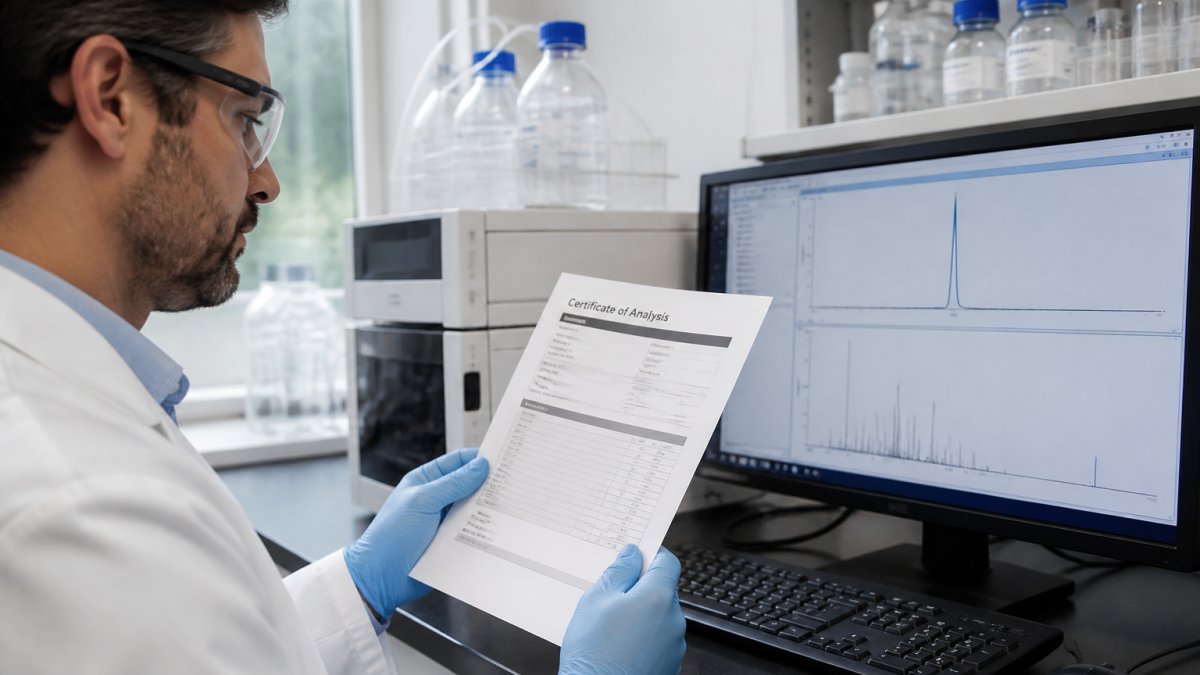
Work through this checklist every time:
- Batch number is printed and matches your vial label
- Testing laboratory is named, with a location and contact details
- Test methods are listed (HPLC method, MS method, column type)
- Purity result is reported as a percentage with the chromatogram attached
- Identity result shows observed mass versus theoretical mass
- Date of analysis is recent and precedes the ship date
- Authorized signature or lab seal is present
If any line is missing, ask the supplier for a complete COA before you use the material. A purity number without a chromatogram is a claim, not evidence.
Matching Batch Numbers and Verifying Testing Laboratory Credentials
The batch number is the thread that ties your vial to its test data. If the COA says lot A-2291 and your label says A-2292, the document does not apply to your material. No exceptions.
Next, check the lab itself. A credible testing laboratory should be willing to confirm it ran the test. Ask these questions:
- Is the lab independent of the supplier, or owned by them?
- Can the lab confirm the batch number on request?
- Will the supplier share raw data files if your lab wants to review them?
At APEX 100 RESEARCH, every batch is verified through independent third-party laboratories in California, and each order ships with a batch-specific COA.
A COA with no batch number, no method details, or no chromatogram attached is a red flag. Without those three items, you cannot tie the result to your vial or check how the number was produced.
Peptide Batch Verification: Matching Product Labels to Analytical Results
Peptide batch verification means confirming that the physical vial in your hand matches the analytical results in the COA. It is a paperwork exercise, but it catches real problems.
Run this match every time a shipment arrives:
- Read the batch number on the vial label.
- Find the same number on the COA.
- Compare the peptide name and sequence on both.
- Check the stated net content against the label.
- Confirm the COA date is recent.
- File the COA with your sample records.
If any item fails to match, quarantine the vial and contact the supplier before use. Most mismatches are clerical, but you cannot assume that.
Batch traceability also matters for your own records. If a result looks odd six months from now, you need to know which lot produced it. Keep COAs linked to experiment IDs, not just to purchase orders.
What Purity Results Do Not Establish: Limitations of HPLC and MS
A purity result does not establish that a material is safe, sterile, or suitable for any particular use. It reports one thing: the percentage of the sample that matches the target peak under one set of test conditions.
Here is what a 98% HPLC result does not tell you:
- Whether the remaining 2% is water, salt, or a related peptide
- Whether the sample is sterile or free of endotoxin
- Whether the peptide is biologically active in your assay
- Whether the material is stable under your storage conditions
Net peptide content is a separate number. A vial labeled 5 mg may contain 5 mg of total powder but only 3.5 mg of actual peptide once counterions and water are counted. Purity percentage and net content are not the same measurement, and good COAs report both.
Method limits matter too. Every HPLC method has a detection threshold. Impurities below that threshold will not appear on the chromatogram, even if they are present. A purity number is the best estimate the method can produce, not an absolute truth.
How to Verify Peptide Purity: A Step-by-Step Protocol
Here is the full protocol we recommend for any incoming research material. It takes one researcher about 30 minutes per batch once you have the workflow in place.
What you’ll need:
- The vial and its label
- The batch-specific COA
- A lab notebook or electronic record system
- Optional: access to an in-house HPLC or MS system
Step 1: Match the batch number. Compare the number on the vial to the number on the COA. If they differ, stop and contact the supplier.
Step 2: Review the COA checklist. Confirm the lab name, methods, purity percentage, identity result, and signature are all present.
Step 3: Read the chromatogram. Check that the dominant peak is symmetrical and clearly separated from neighboring peaks. Note the retention time.
Step 4: Check the mass spectrum. Confirm the observed mass matches the theoretical mass within the stated tolerance.
Step 5: Compare purity to your threshold. Most research applications call for 95% purity or higher. For sensitive work, 98% is a common floor. Decide your threshold before you order, not after.
Step 6: Verify the testing lab. Confirm the lab is independent and will answer questions about the batch.
Step 7: Record everything. Log the batch number, COA date, and purity result against the experiment ID.
Step 8: Retest if needed. If your work is sensitive to trace impurities, run an in-house check or send a sample to an independent lab.
| Step | Action | Time | What It Catches |
|---|---|---|---|
| 1 | Match batch numbers | 2 min | Wrong COA for your vial |
| 2 | Review COA checklist | 5 min | Missing or incomplete data |
| 3 | Read the chromatogram | 5 min | Poor peak shape, low purity |
| 4 | Check the mass spectrum | 3 min | Wrong or degraded peptide |
| 5 | Compare to threshold | 2 min | Material below your spec |
| 6 | Verify the testing lab | 5 min | Non-independent testing |
| 7 | Record results | 3 min | Traceability gaps |
| 8 | Retest if needed | Varies | Hidden impurities |
Labs that receive material regularly and need a repeatable intake process. The checklist and table above work as a standard operating procedure you can hand to any new team member.
Conclusion: Building a Reliable Verification Workflow
Verification is a habit, not a one-time task. The labs that get consistent results treat every incoming batch the same way: match the batch number, read the COA, check the chromatogram, confirm the mass, and log the result.
That workflow only works if your supplier gives you documents worth checking. APEX 100 RESEARCH ships every order with a batch-specific Certificate of Analysis, sources materials in the USA, and verifies each batch through independent third-party laboratories in California. Every COA confirms ?99% HPLC purity and molecular identity by mass spectrometry, so your intake checklist has real data behind it.
Get started with APEX 100 RESEARCH and build a verification workflow your data can stand on.
Frequently Asked Questions
How do I test my peptides for purity and identity?
Send a sample to an independent analytical laboratory for HPLC and mass spectrometry. HPLC separates the peptide from impurities and reports a purity percentage based on peak area. Mass spectrometry confirms the molecular weight matches the expected peptide. Request a certificate of analysis that includes both results, the batch number, and the testing method. Without both tests, you cannot fully verify peptide purity or identity.
What is a good purity for research peptides?
Most research applications require at least 95% HPLC purity, and many sensitive in-vitro studies need 98% or higher. A purity of 95% means 5% of the material consists of other substances. For studies where impurities could interfere with results, a 98% or 99% threshold is safer. Always check the certificate of analysis for the exact purity percentage and the method used to determine it.
Can HPLC alone confirm peptide identity?
No. HPLC measures purity by separating components and calculating peak area, but it does not tell you what the peptide is. A peptide could be 99% pure yet be the wrong sequence. Mass spectrometry is required to confirm molecular identity by measuring the mass-to-charge ratio and comparing it to the expected molecular weight. Use both tests together for reliable peptide identity testing.
How can I check whether a peptide COA matches its batch?
Compare the batch number printed on the product label with the batch number on the certificate of analysis. They must match exactly. Also verify the testing date, the laboratory name, and the analytical results. If the COA lists a different batch number or lacks a batch-specific reference, the document may not apply to your vial. Contact the supplier for a corrected COA before using the material.