How to Read a Certificate of Analysis: 2026 Lab Guide
Last Updated: October 23, 2026
Quick Summary
To read a certificate of analysis, match the product name, batch number, and lot number to the label first, then confirm the testing laboratory and its accreditation. After that, interpret each analytical result with its units and detection limits, and check safety panels and dates before accepting the batch.
- A single transposed digit in the lot number means the report describes a different batch.
- A result below detection limit is not the same as a zero.
- A purity of 99% by HPLC means 99% of the integrated peak area, not 99% of the vial mass.
- HPLC purity does not confirm molecular identity on its own; mass spectrometry runs alongside it.
- A QR code resolving to a file on the seller’s domain is not independent verification.
Table of Contents
- What a Certificate of Analysis Actually Contains
- How to Read a Peptide COA: A Step-by-Step Method
- HPLC Purity Meaning: What the Percentage Does and Does Not Tell You
- A Peptide Certificate of Analysis Example, Annotated Field by Field
- How to Verify a Certificate of Analysis Before You Trust It
- When Results Fail or Conflict With the Product Label
- Conclusion
- Frequently Asked Questions
What a Certificate of Analysis Actually Contains
A certificate of analysis is a batch-specific laboratory report that documents what a tested sample contains and how it was measured. The document links a product name, a lot number, and a set of analytical results to a specific testing laboratory. For research compounds, that record is the difference between a verified reagent and an unverified one.
APEX 100 RESEARCH ships a batch-specific certificate of analysis with every order, and the structure below reflects what such a report should contain. A complete certificate of analysis carries several core elements:
- Product identification: name, batch number, lot number, and label match
- Testing laboratory name and accreditation details
- Test date, manufacture date, retest date, and expiration date
- Analytical results with units of measurement and detection limits
- Safety panels covering contaminants and residual solvents
The sections that follow walk through each field. The goal is a repeatable reading method, not a one-time check.
How to Read a Peptide COA: A Step-by-Step Method
Reading a peptide COA means matching the document to the physical product first, then confirming who ran the test, then interpreting the numbers. Skipping ahead to the potency figure is the most common mistake. A purity number means little if the lot number does not match the vial.
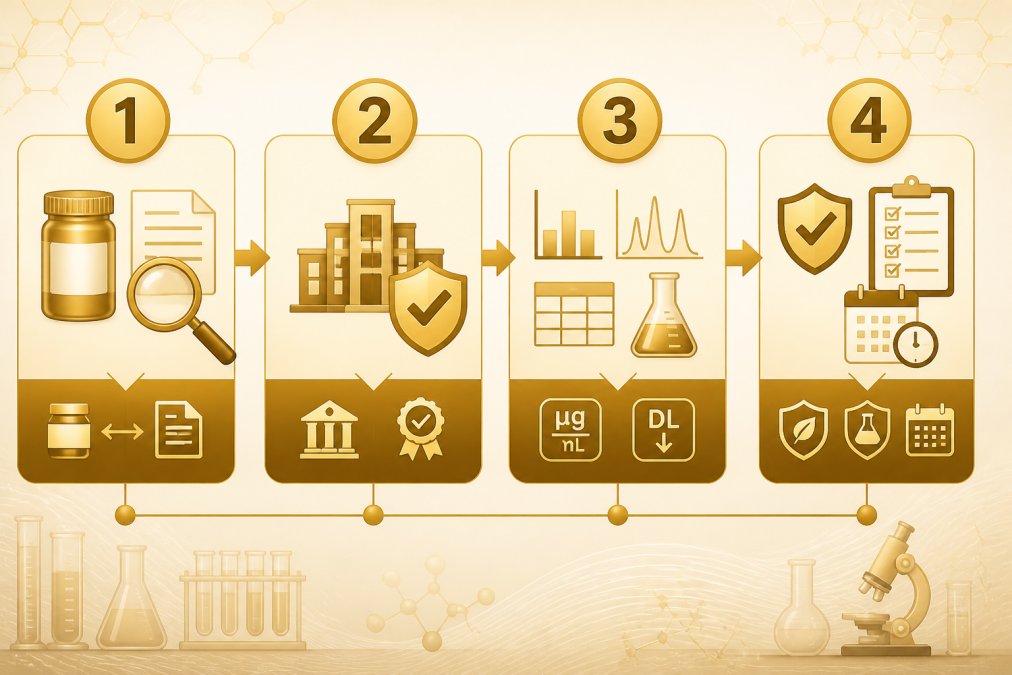
Step 1: Match the Product Name, Batch Number, and Lot Number to the Label
Start with product identification. The product name on the certificate must match the label exactly, including any salt form or concentration notation. Next, compare the batch number and lot number character by character. A single transposed digit means the report describes a different batch.
Researchers describe this as the traceability check. The same traceability logic applies whether the report covers a research peptide, a food ingredient, or an industrial chemical, the lot number is the link between the document and the physical sample.
Step 2: Confirm the Testing Laboratory and Its Accreditation
The report should name the testing laboratory that performed the work. Look for lab accreditation details, since an accredited facility operates under documented quality systems. Independent third-party testing matters here: a report issued by the seller alone carries less weight than one issued by a separate laboratory.
APEX 100 RESEARCH verifies every batch through independent third-party laboratories in California, and the certificate names that laboratory. A reader can use that name to confirm the facility exists and performs the stated test parameters.
Step 3: Read the Analytical Results, Units, and Detection Limits
Analytical results are where most readers jump first. Read them in order: test parameter, method, result, unit, and specification.
Watch the units of measurement. Purity is usually given as a percentage, while concentration may appear in milligrams per milliliter or micrograms per milligram. Mixing units is a frequent source of misreading.
Measurement uncertainty is reported by some laboratories as a range around the result.
Step 4: Check Safety Panels and Dates Before You Accept the Batch
Safety testing panels cover pesticides, heavy metals, microbial testing, pathogens, residual solvents, moisture content, water activity, and foreign matter. Each panel should show a pass or fail against a stated specification. Dates matter too: compare the test date, manufacture date, retest date, and expiration date against the current date.
A batch past its retest date is not automatically unusable, but the results no longer describe the material as it stands today.
Ask for the chromatography data file, not just the summary. A summary page shows the conclusion; the raw file shows the peak integration, the baseline, and the detection limit the laboratory actually used.
HPLC Purity Meaning: What the Percentage Does and Does Not Tell You
HPLC purity meaning comes down to one point: the percentage describes the proportion of the sample that eluted as the target peak under one set of chromatographic conditions.
That is why identity testing runs alongside purity. Mass spectrometry confirms molecular identity by measuring mass, and the two methods together give a fuller picture.
Purity percentages also depend on the detection limit of the method. A method with a high detection limit can report 99% purity while missing low-level impurities entirely.
A Peptide Certificate of Analysis Example, Annotated Field by Field
A peptide certificate of analysis example is easiest to read as a field-by-field walkthrough. Consider a hypothetical report for a lyophilized peptide batch:
| Field | Example Entry | What It Confirms |
|---|---|---|
| Product name | Peptide X, acetate salt | Identity of the material |
| Batch / lot number | Lot 2026-A114 | Traceability to the vial |
| Testing laboratory | Independent lab, California | Third-party testing source |
| Method | HPLC, mass spectrometry | Test parameters used |
| Purity result | ?99% by HPLC | Concentration of target peak |
| Identity result | Mass confirmed | Molecular identity |
| Safety panels | Pesticides, heavy metals, microbial: pass | Contaminant screening |
| Test date | October 2026 | Recency of results |
Read the table left to right. Each row answers a different question, and no single row carries the whole verdict. The batch consistency check sits in the first two rows: if the lot number does not match the label, the rest of the table describes someone else’s material.
How to Verify a Certificate of Analysis Before You Trust It
Verification is the step most readers skip. A certificate of analysis is only as trustworthy as the ability to confirm it came from the named laboratory and describes the named batch. Start by contacting the testing laboratory directly and asking whether it issued the report. This is the single check that most competitors omit, and it is the one that catches the majority of altered or mismatched documents.
Independent Verification of Digital COAs
Digital certificates introduce a specific risk: a PDF can be edited. Independent verification of digital COAs means checking the report against the laboratory’s own records rather than trusting the file alone. Practical steps include:
- Request the raw chromatography data and spectroscopy files, not just the summary page
- Ask the laboratory to confirm the report number and test date
- Compare the report’s accreditation details against the laboratory’s published scope
- Confirm the sample submission date precedes the test date
- Check whether the laboratory provides a portal or QR code that resolves to the original report
A laboratory portal or QR code is the strongest form of independent verification because it resolves to the laboratory’s own record rather than to a file the seller controls. Where a portal exists, the reader should confirm that the report number, lot number, and test date on the portal match the PDF exactly. A QR code that resolves to a generic landing page, or to a file hosted on the seller’s domain, is not independent verification.
Spotting Altered, Expired, or Mismatched Documents
A common pattern in altered reports is a mismatch between the report metadata and the analytical content, a test date that precedes the manufacture date, a lot number that appears in the header but not in the results table, or a laboratory name that does not appear in the laboratory’s published accreditation scope. Expired reports are easier to spot: the retest date or expiration date on the certificate will have passed, and the results no longer describe the material as it stands today.
APEX 100 RESEARCH supplies batch-specific documentation.
A QR code that resolves to a file hosted on the seller’s domain is not independent verification. The code should resolve to the laboratory’s own record, and the report number, lot number, and test date should match the PDF exactly.
When Results Fail or Conflict With the Product Label
A failed result or a label mismatch is a stop signal, not a rounding error. If the certificate reports a potency or concentration that conflicts with the product label, the batch should be set aside pending clarification.
Common conflict scenarios include:
- Purity below the stated specification
- Potency outside the labeled range
- A lot number that does not match the vial
- A missing safety panel for a stated test parameter
- A test date that predates the manufacture date
The correct response is to request a replacement batch or a new certificate, not to average the numbers. APEX 100 RESEARCH issues a batch-specific certificate of analysis with every order so that a mismatch can be traced to a specific lot and resolved against that record.
Accepting a batch whose lot number does not match its certificate is the single most common documentation failure. The analytical results then describe a different sample, and every downstream measurement inherits that error.
Conclusion
Reading a certificate of analysis is a discipline of sequence: match the product and lot, confirm the laboratory, interpret results with their units and detection limits, then check safety panels and dates.
For laboratories that need documented, batch-specific quality records, APEX 100 RESEARCH provides ?99% HPLC purity verification, mass spectrometry identity testing, US-sourced materials, and independent third-party testing in California. Every order includes a batch-specific certificate of analysis, and the research compound catalog lists the full range of available materials.
For research use only, not only —. Not medical advice.
Frequently Asked Questions
What does a certificate of analysis look like?
A certificate of analysis is a batch-specific laboratory test report. It typically lists the product name, batch number and lot number, the testing laboratory and its accreditation, the test date and retest date, and the analytical results for each test parameter. For research peptides, the report usually includes an HPLC chromatogram for purity, mass spectrometry data for molecular identity, and safety panels covering contaminants such as heavy metals, microbial testing, and residual solvents. The document should match the product label exactly, and any missing field is a reason to request clarification rather than assume the result.
How do you tell if a certificate of analysis is real?
Authenticity is checked by cross-referencing, not by appearance. Compare the batch number and lot number on the COA with the product label, confirm the testing laboratory exists and holds accreditation, and look for a test date that precedes the shipment. Digital COAs can be verified by contacting the laboratory directly or checking any report identifier the lab provides. A report that lists no laboratory, no batch number, or results without units of measurement should be treated as unverified. Researchers describe independent verification as the only reliable way to confirm a COA was issued for the batch in hand.
What is the difference between purity and identity on a certificate of analysis?
Purity and identity answer different questions. Purity, usually reported as an HPLC percentage, describes how much of the detected material is the target compound versus related impurities. Identity confirms that the compound is the correct molecule, typically through mass spectrometry or spectroscopy. A sample can be 99% pure and still be the wrong peptide, so a COA that reports purity without an identity test is incomplete. Both values should appear on the report, and researchers should check that the identity result matches the expected molecular weight for the specific lot.
What should you do if a certificate of analysis has missing or unclear results?
Request the missing data before using the material. Ask the supplier for the full laboratory report, including chromatograms, spectroscopy files, and the detection limit for each test. If the results conflict with the label, quarantine the batch and ask for a replacement or a retest from an independent laboratory. Researchers describe this as a documentation failure rather than a minor clerical issue, because a COA without complete test parameters cannot support reproducibility. Keep the correspondence and the original report on file for audit purposes.