Independent Lab Testing for Peptides: A 2026 Guide
Table of Contents
- Independent Lab Testing for Peptides: What It Verifies
- Peptide Identity Testing: Confirming Molecular Identity
- How to Read an HPLC Chromatogram: A Researcher’s Guide
- The Peptide Certificate of Analysis: What It Should Contain
- Peptide Batch Consistency Testing: Verifying Reproducibility
- Assessing Laboratory Independence, Method Validation, and Accreditation
- Comparing Testing Approaches and What Purity Results Do Not Establish
- Frequently Asked Questions
Last Updated: October 19, 2026
Independent Lab Testing for Peptides: What It Verifies
Independent lab testing for peptides is the analysis of a peptide sample by a laboratory with no financial stake in the outcome, performed to confirm purity, molecular identity, and the absence of contaminants. For research teams sourcing compounds for in-vitro work, that third-party verification is the difference between a documented reagent and an unverified one. APEX 100 RESEARCH commissions batch-specific analysis through independent laboratories in California and ships a Certificate of Analysis with every order. The sections below examine what each test measures, how to read the data, and where the limits of that data begin.
A peptide Certificate of Analysis typically reports three things: a purity percentage derived from chromatographic peak area, a molecular mass consistent with the expected structure, and a description of the analytical methods used. What it does not report matters just as much, and later sections address that gap directly.
Peptide Identity Testing: Confirming Molecular Identity
Peptide identity testing confirms that the material in the vial matches the declared sequence and molecular formula, rather than merely resembling it. Two techniques carry most of that burden. Mass spectrometry measures the molecular mass of the intact compound and its fragments; a match within the method’s mass accuracy tolerance supports the proposed structure. Sequence confirmation, often by tandem mass spectrometry or Edman degradation, resolves the amino acid order itself.
Purity and identity are separate questions. A sample can be 99% pure and still be the wrong peptide, a point that peptide identity testing exists to catch and that a purity figure alone will never reveal.
How to Read an HPLC Chromatogram: A Researcher’s Guide
Reading an HPLC chromatogram means locating the main analyte peak, measuring its area against the total integrated peak area, and inspecting what else the trace contains. The x-axis shows retention time in minutes; the y-axis shows absorbance in milli-absorbance units at the detection wavelength, commonly 214 nm for the peptide backbone.
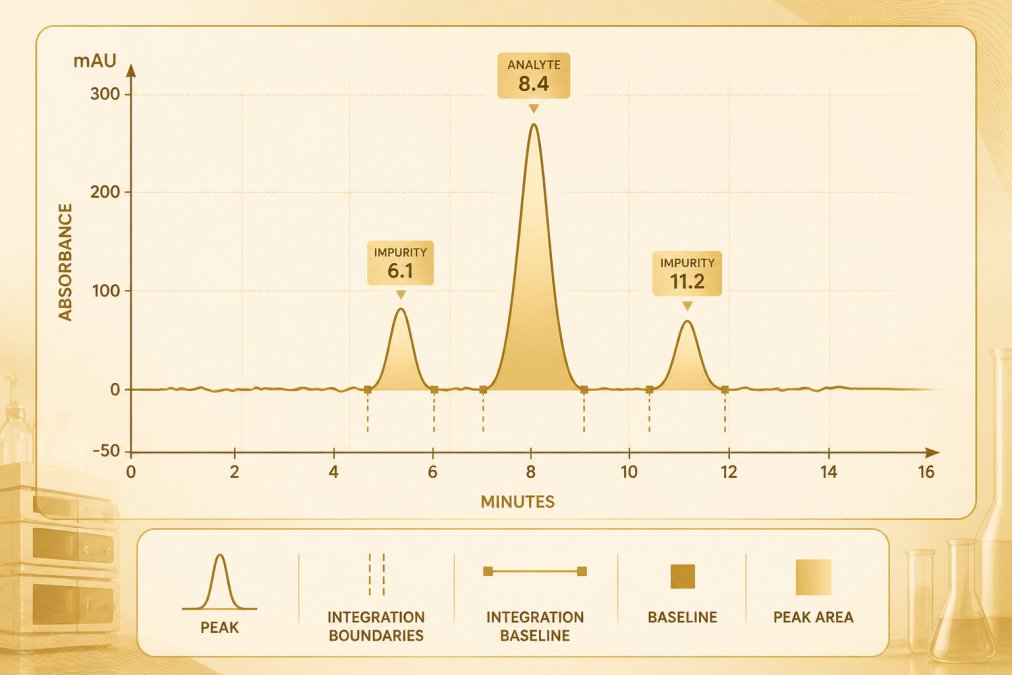
A common mistake is reading the tallest peak as the purest result. Peak height reflects concentration and detector response; peak area reflects quantity. Integration settings also change the number: a shallow shoulder merged into the main peak disappears from the calculation entirely. When comparing certificates, confirm the integration parameters match.
The Peptide Certificate of Analysis: What It Should Contain
A peptide Certificate of Analysis should contain, at minimum, the batch or lot identifier, the analytical methods with instrument parameters, the chromatogram and mass spectrum, the calculated purity percentage, the measured molecular mass against the theoretical value, and the date of analysis. Storage conditions and the testing laboratory’s identity belong on the document as well.
- Batch or lot number traceable to the vial
- HPLC method: column dimensions and particle size, mobile phase composition, gradient program, detection wavelength, flow rate, run time, and injection volume
- Chromatogram image with integration boundaries visible and baseline marked
- Mass spectrometry method: ionization source, mass analyzer type, scan range, and resolution; measured versus theoretical mass with mass accuracy tolerance stated
- Purity percentage with the calculation method stated (peak area normalization versus external standard)
- Testing laboratory name, address, and analysis date
- Storage and handling conditions
- Chain-of-custody documentation or sample receipt record
What most guides miss is that a certificate is a summary of raw data, not the data itself. Researchers who need the underlying chromatography and spectroscopy files should request them before ordering, because not every supplier retains or releases them.
A certificate that lists a purity figure without stating the method, column, gradient, and detection wavelength cannot be independently assessed. Treat an unmethodical certificate as a marketing document, not an analytical record. Similarly, a mass spectrometry result reported only as “consistent with expected mass” without stating the measured value, theoretical value, and mass accuracy tolerance provides no basis for evaluation.
Researchers comparing certificates across suppliers should also note whether the document reports the number of injections or replicates. A single injection provides no information about method precision; duplicate or triplicate injections with relative standard deviation reported give the reader a basis for judging reproducibility. The United States Pharmacopeia general chapters on chromatographic analysis describe system suitability parameters, resolution, tailing factor, and relative standard deviation of replicate injections, that a well-documented certificate may reference. The FDA guidance on analytical procedures and methods validation outlines the validation expectations that underlie credible method documentation.
Peptide Batch Consistency Testing: Verifying Reproducibility
Peptide batch consistency testing verifies that successive lots of the same compound perform comparably, which matters more to a longitudinal study than any single certificate. A study running across months may draw from three or four lots; if purity drifts between them, the variable changes mid-experiment. Batch-level verification compares chromatographic profiles, retention times, and measured masses across lots and flags divergence.
Repeat testing of a retained sample from the same lot, sometimes months apart, tests stability as well as consistency. Researchers designing long protocols should ask whether the supplier retains reference samples and whether historical certificates for prior lots are available for comparison.
Assessing Laboratory Independence, Method Validation, and Accreditation
Laboratory independence is the property that makes a third-party result meaningful, and it is harder to verify than a logo on a certificate. A laboratory owned by, contracted exclusively to, or financially dependent on the supplier has an interest in favorable results.
Method validation establishes that an analytical procedure reliably measures what it claims to measure, within stated limits of detection and quantification. Validation parameters include accuracy, precision, specificity, linearity, range, limit of detection, limit of quantification, and robustness.
Accreditation signals that a laboratory operates under a recognized quality system with documented procedures, calibration records, and proficiency testing. In the United States, accreditation bodies assess laboratories against ISO/IEC 17025, which covers general requirements for the competence of testing and calibration laboratories.
Sampling and chain of custody deserve equal weight. A result is only as representative as the sample submitted: material drawn from the top of a container may not reflect the lot, and a sample without documented custody cannot be tied to the vial in use. Chain of custody documentation should record who collected the sample, when, from which container, and how it was sealed and shipped. A result from a sample with no custody record establishes that some material was tested, not that the material in the researcher’s vial was.
What purity results do not establish deserves explicit statement. The United States Pharmacopeia general chapters publishes reference standards and general chapters on chromatographic analysis that researchers can use to benchmark reported methods, and the National Center for Biotechnology Information literature database indexes the primary analytical literature on peptide characterization.
Comparing Testing Approaches and What Purity Results Do Not Establish
Testing approaches differ along four axes: who performs the analysis, which methods are applied, how much documentation accompanies the result, and how the sample is handled before it reaches the instrument. The table below summarizes the trade-offs.
| Approach | Independence | Documentation Depth |
Best For |
|---|---|---|---|
|
Supplier in-house testing |
Low |
Variable |
Internal screening only |
|
Contracted third-party laboratory |
Moderate to high |
Method-level detail |
Routine batch release |
|
Independent laboratory with raw data release |
High |
Full chromatograms and spectra |
Studies requiring auditability |
|
Academic or core facility analysis |
High |
Full, with method notes |
Method development and validation |
Sampling and chain of custody deserve equal weight. A result is only as representative as the sample submitted: material drawn from the top of a container may not reflect the lot, and a sample without documented custody cannot be tied to the vial in use.
Purity results do not establish identity, sterility, endotoxin content, or suitability for any particular experimental system. A 99% purity figure describes chromatographic behavior at one wavelength under one method. It says nothing about the 1% it excludes, which may be water, counterion, residual solvent, or a closely related impurity.
APEX 100 RESEARCH verifies each batch through independent third-party laboratories in California, reporting ?99% HPLC purity and molecular identity on a batch-specific Certificate of Analysis, with materials sourced in the United States. The FDA guidance on analytical procedures and methods validation outlines the validation expectations that underlie credible method documentation, and the United States Pharmacopeia general chapters publishes reference standards for chromatographic analysis that researchers can use to benchmark reported methods. For background on how peptide reagents are handled in laboratory settings, the National Center for Biotechnology Information literature database indexes the primary analytical literature.
Researchers face a genuine problem: certificates are easy to produce and hard to audit, and the difference between a documented result and a decorative one is invisible until a study fails. The research compound catalog lists available materials, and the peptide research guide covers handling and reconstitution for laboratory work.
For research use only, not only —. Not medical advice.
Frequently Asked Questions
What is the difference between peptide purity and peptide identity?
Purity describes the proportion of the sample represented by the main analyte peak, typically reported as an HPLC area percentage. Identity confirms that the molecule is the expected sequence and mass, usually through mass spectrometry and sequence confirmation. A sample can be 99% pure by HPLC area and still be the wrong peptide if identity testing is absent. Independent lab testing for peptides should report both, because purity alone does not establish that the material matches the intended sequence.
What analytical methods are used to confirm peptide identity?
Mass spectrometry, commonly electrospray ionization or MALDI-TOF, measures molecular mass against the theoretical value. Tandem mass spectrometry with fragmentation supports sequence confirmation. Liquid chromatography, including HPLC and UHPLC, separates components and supports purity assessment. Amino acid analysis and sequencing techniques may be used where sequence-level confirmation is required. Researchers describing peptide identity testing generally expect at least mass confirmation plus chromatographic purity from an independent laboratory.
What are the limitations of HPLC testing for peptides?
HPLC area percentage is method-dependent. Compounds that co-elute with the main peak are not resolved and can inflate apparent purity. UV absorbance at 214 nm responds to the peptide backbone, so structurally related impurities may be under- or over-represented. Without method validation data, including limits of detection and uncertainty, a purity percentage should be read as an estimate under the stated conditions. Independent lab testing for peptides is strongest when HPLC is paired with mass spectrometry and impurity screening.
How can researchers verify that a peptide test report matches a specific batch?
The report should carry a unique batch or lot identifier, the sample submission date, and the analytical method used. Matching the batch number on the Certificate of Analysis to the vial label is the first check. Requesting raw chromatography data and mass spectra files, rather than only the summary page, allows the receiving laboratory to review integration and peak assignment. Where chain of custody documentation exists, it supports sample representativeness from the supplier through the testing laboratory.
How can researchers assess consistency between peptide batches?
Peptide batch consistency testing compares chromatographic profiles, retention times, and mass results across lots produced under the same method. Consistent retention time and peak shape, with mass within the method’s uncertainty, supports reproducibility. Reviewing several consecutive COAs, not a single report, shows whether the supplier’s process holds. Independent lab testing for peptides adds value here because a laboratory without a commercial interest in the batch can report variation plainly.
What should a peptide Certificate of Analysis include?
A peptide Certificate of Analysis should identify the compound, batch or lot number, and testing laboratory; state the analytical methods used; report purity percentage with the method and detection wavelength; give molecular mass and the theoretical value; and include the date of analysis and a signature or authorization. Supporting documents such as the chromatogram and mass spectrum are commonly appended. The document should distinguish measured results from specifications so readers can judge analytical accuracy.