Buying High Purity Peptides for Research: A 2026 Guide
Table of Contents
- Why Purity Claims Alone Don’t Guarantee Research-Grade Peptides
- What a Peptide Certificate of Analysis Must Contain
- Peptide Purity Testing: HPLC, Mass Spectrometry, and Independent Verification
- Peptide Identity Verification: Confirming Molecular Structure, Not Just Purity
- How to Evaluate Research Peptide Suppliers Before You Buy
- Storage, Handling, and Shipping Integrity for Lyophilized Peptides
- Frequently Asked Questions
Last Updated: October 16, 2026
Why Purity Claims Alone Don’t Guarantee Research-Grade Peptides
A stated purity percentage is the least reliable thing on a supplier’s label for high purity peptides. This guide from APEX 100 RESEARCH examines what purity figures actually measure, what a certificate of analysis must contain, and how laboratory buyers can audit a supplier before committing to a purchase order.
The stakes are practical rather than abstract. A peptide reagent that is 97 percent pure by one integration method and 99 percent by another is not a different molecule, but it is a different experimental variable.
Most supplier pages lead with a purity guarantee and stop there. The sections below explain why that is insufficient, and what documentation a laboratory should demand instead.
A purity percentage printed without a method, a column type, a detection wavelength, and a batch number is not evidence. Treating it as evidence is the most common sourcing error in academic and industrial labs alike.
What HPLC Purity Percentages Actually Measure
High-performance liquid chromatography separates components in a sample by their interaction with a stationary phase, then detects them as they elute.
That number describes relative abundance of UV-absorbing species at one wavelength, typically 214 nm for the peptide backbone. It does not describe what the impurities are. A sample can read 99 percent pure while containing a closely eluting sequence variant that co-migrates with the target.
Three variables change the reported figure without changing the material:
- Detection wavelength: 214 nm captures the amide backbone; 280 nm captures aromatic residues only.
- Integration parameters: Where the baseline is drawn determines how much impurity area is counted.
- Column and gradient: Different stationary phases resolve different impurity classes.
A purity percentage is therefore a method-dependent measurement, not a fixed property of a compound.
What a Peptide Certificate of Analysis Must Contain
A peptide Certificate of Analysis is a batch-specific document that reports analytical results for the exact lot shipped, not a representative specification for the product line. The distinction matters because a specification sheet describes what a supplier intends to produce, while a COA describes what was measured on the material in the vial.
A COA that supports research use typically includes the following elements:
| COA Element | What It Establishes | Common Omission |
|---|---|---|
| Batch or lot number | Traceability to a specific synthesis run | Generic lot codes reused across products |
| HPLC chromatogram | Purity percentage and impurity profile | Peak area stated without the trace |
| Mass spectrometry result | Molecular identity confirmation | Theoretical mass only, no observed spectrum |
| Method parameters | Column, gradient, wavelength, integration | Method described as “standard HPLC” |
| Testing laboratory | Identity of the independent lab | In-house testing presented as third-party |
| Storage and handling | Recommended conditions for the material | Absent entirely |
The omission column is where most documentation fails. A COA without a chromatogram image, or with a mass value that matches the theoretical mass but shows no observed spectrum, cannot be independently assessed.
Batch-Specific Documentation and Why It Matters
Batch-specific documentation allows a laboratory to match the material in hand to the analytical record.
APEX 100 RESEARCH provides a batch-specific Certificate of Analysis with every order, confirming ?99% HPLC purity and molecular identity, with testing performed by independent third-party laboratories in California.
For laboratories performing molecular identity testing in-house, the practical question is whether raw data is available. Summary values on a COA cannot be re-integrated or re-analyzed; chromatography and spectroscopy files can.
Peptide Purity Testing: HPLC, Mass Spectrometry, and Independent Verification
Peptide purity testing combines a separation method with an identity method, because neither alone is sufficient. HPLC answers “how much of this is the target peak,” while mass spectrometry answers “is the target peak the expected molecule.”
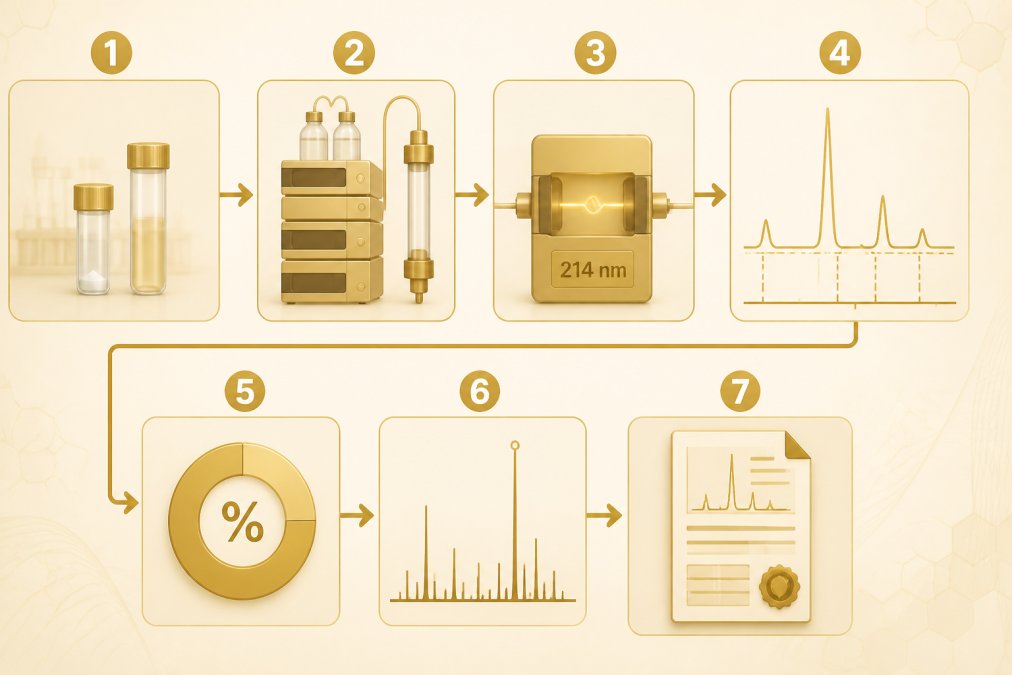
Independent verification means the testing laboratory has no commercial interest in the result. The U.S. Pharmacopeia general chapters on analytical quality describe the general expectations for chromatographic identity and purity testing that inform this kind of documentation.
Ask whether the testing laboratory can be contacted directly. Suppliers who route all technical questions through a sales desk, and who cannot name the lab, are usually testing in-house and reporting it as third-party.
Peptide Identity Verification: Confirming Molecular Structure, Not Just Purity
Peptide identity verification confirms that the synthesized sequence matches the intended molecular structure, and it is a separate determination from purity.
Mass spectrometry is the standard method. The observed mass-to-charge spectrum is compared against the theoretical mass calculated from the intended sequence.
Researchers describe mass confirmation as necessary but not always sufficient. For peptides with isobaric residues or close sequence variants, tandem mass spectrometry or amino acid analysis may be required to resolve ambiguity.
How to Evaluate Research Peptide Suppliers Before You Buy
Research peptide suppliers differ less in what they claim than in what they will document. Evaluation should therefore focus on verifiable process rather than stated specifications. The sections below set out a transparent methodology, the criteria used, the weight given to each, and the limitations of the approach, so that a laboratory can apply the same framework independently.
A Transparent Evaluation Methodology
Supplier reliability rests on four weighted criteria. The weighting reflects what is independently checkable rather than what is marketed:
| Criterion | Weight | What Is Assessed |
|---|---|---|
| Documentation completeness | 40% | Batch-linked COA, full chromatogram, observed mass spectrum, stated method parameters |
| Testing independence | 25% | Named external laboratory, contactable, no commercial interest in the result |
| Out-of-specification policy | 20% | Stated replacement or refund terms for material failing the documented specification |
| Inventory consistency | 15% | Ability to supply the compounds a laboratory actually uses without splitting orders across vendors |
This framework has limitations. It cannot assess synthesis quality directly, it depends on the accuracy of the documents a supplier provides, and it does not weight price, a legitimate factor that is deliberately excluded because low price is frequently a signal of undocumented material rather than a benefit. A supplier that meets a purity claim but cannot produce a batch-matched COA has not met the standard regardless of price.
Verifying a Certificate of Analysis Against a Specific Batch
A COA is only meaningful when it can be matched to the material in hand. The verification steps below are the ones most commonly skipped:
- Match the lot number. The lot or batch code on the COA must match the code on the vial label exactly. Generic codes reused across products indicate a specification sheet, not a batch record.
- Check the report date. The COA date should fall within the manufacturing window for the lot, not predate it or postdate the shipment by an implausible margin.
- Confirm the method. Column type, gradient, detection wavelength, and integration parameters should be stated. A purity figure without a method is not evidence.
- Inspect the chromatogram. The trace should be included, not just a peak-area percentage. Baseline placement determines how much impurity area is counted.
- Inspect the mass spectrum. An observed spectrum should accompany the theoretical mass. A theoretical value alone does not confirm identity.
- Confirm laboratory independence. The testing laboratory should be named and contactable. In-house testing presented as third-party is a common failure.
What Purity Percentages Do, and Do Not, Tell Buyers
A headline purity figure describes the relative abundance of UV-absorbing species at one wavelength, typically 214 nm for the peptide backbone. It does not establish identity, it does not describe what the impurities are, and it does not establish suitability for a given assay. A sample can read 99 percent pure while containing a closely eluting sequence variant that co-migrates with the target.
A Practical Supplier-Vetting Checklist
- Does the COA carry a batch or lot number that matches the vial label?
- Is the full HPLC chromatogram included, not just a percentage?
- Is an observed mass spectrum reported alongside the theoretical mass?
- Are method parameters stated: column, gradient, wavelength, integration?
- Is the testing laboratory named, and can it be contacted?
- Is the material described as research-grade and labeled research use only?
- Is a replacement policy stated for material that fails to meet the documented specification?
- Are raw chromatography and spectroscopy files available on request?
- Is storage guidance provided for lyophilized powder?
- Is the supplier’s inventory consistent enough to avoid splitting orders across vendors?
The single most useful question in supplier evaluation is not “what is your purity” but “can you send the chromatogram and mass spectrum for this lot.” Suppliers who can answer immediately are operating a documented process.
Storage, Handling, and Shipping Integrity for Lyophilized Peptides
Lyophilized powder is the standard shipping form for research peptides because removing water limits hydrolysis during transit. Integrity depends on the cold chain, on packaging, and on how the vial is handled after arrival, a topic that vendor pages rarely address in detail.
Cold-Chain and Packaging Integrity
Shipping conditions matter more than shipping speed for most compounds. A vial that arrives warm after a short transit may be in better condition than one that spent days in a hot distribution hub. A common pattern in receiving laboratories is to record arrival temperature, inspect the vial seal, and confirm that the lyophilized cake is intact before accepting a shipment.
Storage Conditions for Lyophilized Powder
Storage guidance varies by sequence. Many lyophilized peptides are stable at reduced temperature for extended periods, while reconstituted solutions are typically less stable and are handled according to the specific compound’s properties. The NIH guidance on research reagent handling and biospecimen integrity reflects the general principle that documented handling conditions are part of the material’s provenance, not an afterthought. Laboratories should record storage temperature, desiccant status, and the date of first reconstitution for each lot.
Reconstitution and Post-Reconstitution Handling
Reconstitution introduces variables that are frequently undocumented. The choice of solvent, the final concentration, and the time between reconstitution and use all affect stability. Researchers describe aggregation, adsorption to container surfaces, and sequence-dependent degradation as recurring confounders in in-vitro work. For laboratories that need to calculate solvent volumes and final concentrations precisely, a dedicated Peptide Reconstitution Calculator is a useful bench tool, and the Research Compound Catalog provides reference specifications for the compounds a laboratory may be working with.
Documentation of Handling Conditions
Handling records are part of the analytical record. A receiving laboratory that logs arrival temperature, storage conditions, and reconstitution details can match the material in hand to its COA and to its downstream assay results. Without those records, the material’s provenance is incomplete regardless of the purity figure on the label.
A vial that arrives warm after a short transit may be in better condition than one that spent days in a hot distribution hub. Shipping speed alone is not a reliable proxy for cold-chain integrity.
For research use only, not only —. Not medical advice.
Frequently Asked Questions
How can researchers verify peptide purity?
Researchers verify peptide purity primarily through reverse-phase HPLC, which separates peptide species by hydrophobicity and quantifies the main peak as a percentage of total peak area. A purity claim without a supporting chromatogram is incomplete. Independent third-party testing adds a layer of confidence because the analysis is not performed by the supplier. Mass spectrometry complements HPLC by confirming molecular identity alongside purity. For research use only, not only —. Not medical advice.
What should a peptide Certificate of Analysis include?
A thorough peptide Certificate of Analysis should include the peptide name and sequence, lot or batch number, molecular weight, HPLC chromatogram with retention time, purity percentage, mass spectrometry data, date of analysis, and the name of the testing laboratory. Batch-specific COAs allow researchers to match documentation to the exact vial received. If a supplier provides only a generic COA without a batch number, the documentation cannot be tied to a specific production run. For research use only. Not medical advice.
What is the difference between HPLC purity and peptide identity?
HPLC purity measures what proportion of the sample is the target peptide versus related impurities, expressed as a percentage. Peptide identity verification confirms that the dominant peak is the correct molecular structure, typically through mass spectrometry. A sample could show 99% purity by HPLC yet still be the wrong peptide if the synthesis produced an unintended sequence. Both measures are necessary: purity without identity verification leaves a gap in quality control. For research use only. Not medical advice.
What should researchers check before storing a research peptide?
Lyophilized peptides should be stored at -20°C or lower, protected from light and moisture, according to the supplier’s specifications. Before storage, researchers should confirm the vial is sealed, record the batch number and receipt date, and file the COA alongside the inventory entry. Repeated freeze-thaw cycles can degrade peptide integrity, so aliquoting reconstituted material is common practice. Storage conditions should be documented as part of the laboratory’s standard operating procedures. For research use only. Not medical advice.