A Guide to Research Peptides for In Vitro Studies
Last Updated: November 21, 2026
Quick Summary
Research peptides for in vitro studies are short amino acid chains supplied for laboratory investigation only, distinguished from therapeutic peptides by regulatory status and documentation rather than chemical structure. Serious laboratories expect ?99% HPLC purity, batch-specific Certificates of Analysis, and mass spectrometry identity confirmation before committing to a lot.
- 37.8% of classified peptide publications concern human clinical research, while 39.1% concern animal, cell, or computational studies.
- HPLC purity is method-dependent, so comparing percentages across laboratories without the chromatogram is not a comparison.
- Lyophilized peptides are generally held at ?20 °C or ?80 °C, desiccated, and protected from light.
- Final DMSO concentration in assays should be kept below 0.1% (v/v) where possible.
- A scrambled-sequence peptide control tests whether an effect depends on sequence rather than peptide presence generally.
Table of Contents
- What Research Peptides Are and How They Differ from Therapeutic Peptides
- HPLC Purity Standards for Research Peptides
- How to Interpret a Certificate of Analysis for Peptides
- Best Practices for In Vitro Peptide Storage, Reconstitution, and Stability
- Selecting Research Peptides for a Specific In Vitro Assay
- Bioactive Peptides in Cellular, Biochemical, and Structural Studies
- Limitations of In Vitro Findings and Research-Use Boundaries
- Sourcing Research Peptides with Documented Quality
- Frequently Asked Questions
What Research Peptides Are and How They Differ from Therapeutic Peptides
Research peptides for in vitro studies are short chains of amino acids supplied specifically for laboratory investigation, and their defining feature is regulatory status rather than chemical structure. According to State of Peptide Research 2026, 37.8% of classified peptide publications concern human clinical research while 39.1% concern animal, cell, or computational studies, a distribution that reflects how much peptide work happens outside the clinic.
The distinction matters because regulatory guidance written for therapeutic peptides is frequently misread as a universal bench protocol. Research compounds are supplied for laboratory use only, and that framing determines which standards apply and which do not.
Peptide Nomenclature, Sequence, and Post-Translational Modifications
Peptide nomenclature encodes sequence, and sequence determines everything downstream. A peptide’s name typically specifies its residue chain in single-letter or three-letter amino acid code, and the sequence defines molecular weight, charge distribution, and folding behavior under assay conditions. Ozawa and coauthors describes an in vitro system that couples three post-translational modification enzymes to prepare bioactive peptides, illustrating how modification state can be engineered rather than assumed (Production of Bioactive Peptides in an In Vitro System(https://pmc.ncbi.nlm.nih.gov/articles/PMC2128726/)).
HPLC Purity Standards for Research Peptides
HPLC purity for research peptides is reported as the percentage area of the target peak relative to total chromatographic area, and ?99% is the threshold serious laboratories expect. Readers encountering these figures for the first time can consult a practical guide to understanding HPLC purity for research.
What most guides miss is that purity percentage is method-dependent. Column chemistry, gradient, wavelength, and injection load all shift the reported figure. Comparing a 98% result from one laboratory against a 99% result from another without the chromatogram is not a comparison at all.
How to Interpret a Certificate of Analysis for Peptides
A Certificate of Analysis is a batch-specific document that records analytical results for a defined lot, and reading it correctly means reading the methods alongside the numbers. Four fields carry most of the diagnostic weight:
- Batch or lot number ties the document to the specific material received, not to a catalog entry.
- HPLC purity percentage with retention time confirms the main peak and its elution position.
- Mass spectrometry result compares observed molecular weight against the theoretical value calculated from the sequence.
The mass spectrometry field is where identity is actually confirmed. A purity figure without a matching mass is an incomplete record. For a step-by-step walkthrough of each field, see how to read a certificate of analysis.
Analytical Methods Behind the COA: HPLC and Mass Spectrometry
HPLC separates components by differential affinity to a stationary phase, and the resulting chromatogram shows how many species elute and in what proportion. Mass spectrometry then ionizes the sample and measures mass-to-charge ratios, confirming that the dominant species matches the expected sequence. Elsayed and coauthors reports that regulatory bodies including the FDA, ICH, and EMA have established guidance covering peptide analysis, stability testing, and quality control (Regulatory Guidelines for the Analysis of Therapeutic Peptides and Proteins(https://pmc.ncbi.nlm.nih.gov/articles/PMC11806371/)).
Best Practices for In Vitro Peptide Storage, Reconstitution, and Stability
Storage and reconstitution decisions determine whether a verified peptide stays verified at the bench.
Solvent selection is the first decision after reconstitution.
Watch out: reconstituting an entire vial into a single stock and thawing it repeatedly for each experiment is the most common way a high-purity peptide degrades before it ever reaches an assay.
Stability windows vary widely by sequence. Elsayed and coauthors notes that regulatory guidance from the FDA and ICH addresses stability testing for therapeutic peptides, but that guidance is not a bench protocol for every research compound (Regulatory Guidelines for the Analysis of Therapeutic Peptides and Proteins(https://pmc.ncbi.nlm.nih.gov/articles/PMC11806371/)).
For deeper contamination-avoidance guidance, see mitigating peptide contamination in in vitro research.
The article sets out the handling conditions and degradation pathways that determine whether a verified peptide stays verified at the bench.
| Item | Value or condition | Note |
|---|---|---|
| Lyophilized peptide storage | ?20 °C or ?80 °C, desiccated, protected from light | Generally held under these conditions |
| Reconstituted stock | Aliquoted and frozen | Avoid repeated freeze-thaw cycles |
| Final DMSO concentration in assay | Below 0.1% (v/v) where possible | Higher levels investigated for effects on cells |
| Hydrolysis | Peptide bonds, particularly at aspartic acid residues | Accelerated by acidic or basic pH extremes |
| Oxidation | Methionine and cysteine residues | Accelerated by dissolved oxygen and trace metal ions |
| Aggregation | Driven by hydrophobic interactions | Accelerated by high concentration and freeze-thaw cycling |
| Short, unmodified sequences in aqueous buffer | Often stable for days to weeks at 4 °C | Stability must be confirmed empirically per sequence |
Selecting Research Peptides for a Specific In Vitro Assay
Selection starts from the assay, not the catalog. The sequence must match the biological question, the purity must match the sensitivity of the detection method, and the quantity must match the number of conditions and replicates planned. A practical framework:
- Define the target pathway or binding interaction the assay measures. For a receptor activation study, the sequence must match the known agonist or antagonist motif; for a binding assay, the labeled or unlabeled format must be compatible with the detection method.
- Confirm the sequence against published literature for that target. Sequence variants, truncations, point mutations, or D-amino acid substitutions, can alter potency and stability, and the literature should specify which variant was studied.
- Match purity to detection sensitivity: immunoassays tolerate less than mass spectrometry. A peptide at 95% purity may be adequate for a colorimetric assay but insufficient for a quantitative mass spectrometry workflow where trace truncation products can interfere with quantification.
- Calculate total mass needed across all conditions, replicates, and pilot runs. Include extra for reconstitution losses and for a pilot run to confirm solubility and assay response.
- Verify documentation before committing to a lot. The Certificate of Analysis should report HPLC purity, mass spectrometry identity, and the testing laboratory.
Controls, Replicates, and Assay Validation
Controls and replicates are what convert a signal into a finding. A scrambled-sequence peptide control tests whether an observed effect depends on sequence rather than on peptide presence generally, and a vehicle control isolates solvent effects. For receptor-binding studies, a known agonist or antagonist at a defined concentration serves as a positive control, while buffer alone serves as a negative control.
A common pattern is to run a pilot experiment with a concentration range spanning at least three orders of magnitude (e.g., 1 nM to 10 µM) to identify the linear response window before committing to a full study. Researchers describe that assay validation for peptide work should include confirmation of peptide identity after reconstitution (by mass spectrometry or HPLC) and a check that the vehicle alone does not produce the measured signal. The limits of the evidence base are worth stating: for many research peptides, published assay protocols are sparse, and the literature often reports results from a single laboratory without independent replication. Matching the sequence, purity, and format to the experimental objective, and documenting the controls that rule out nonspecific effects, is the difference between a reproducible result and an artifact.
Bioactive Peptides in Cellular, Biochemical, and Structural Studies
Bioactive peptides are studied across three experimental contexts, and each imposes different demands on material quality. In cellular models, peptides are investigated for effects on signaling pathways, viability, and receptor activation, where endotoxin and residual solvent matter as much as purity. In biochemical assays, enzyme kinetics and binding affinity measurements depend on accurate concentration, which in turn depends on confirmed molecular identity and counterion content. In structural biology, crystallography and NMR work require material pure enough that a single species dominates the sample.
Limitations of In Vitro Findings and Research-Use Boundaries
In vitro results describe behavior under controlled conditions and do not establish in vivo outcomes. A peptide that activates a receptor in a cell line may behave differently in tissue, where metabolism, protein binding, and compartmentalization intervene.
Research-use-only designation carries legal weight. Materials supplied under that status are not only —, and laboratories should confirm that their institutional protocols and qualified-buyer requirements align. APEX 100 RESEARCH publishes its compliance and qualified-buyer policies, including prohibited uses and lot-specific documentation.
Sourcing Research Peptides with Documented Quality
Documented quality is the variable that most directly affects reproducibility, and it is the one researchers have the least ability to verify independently after purchase.
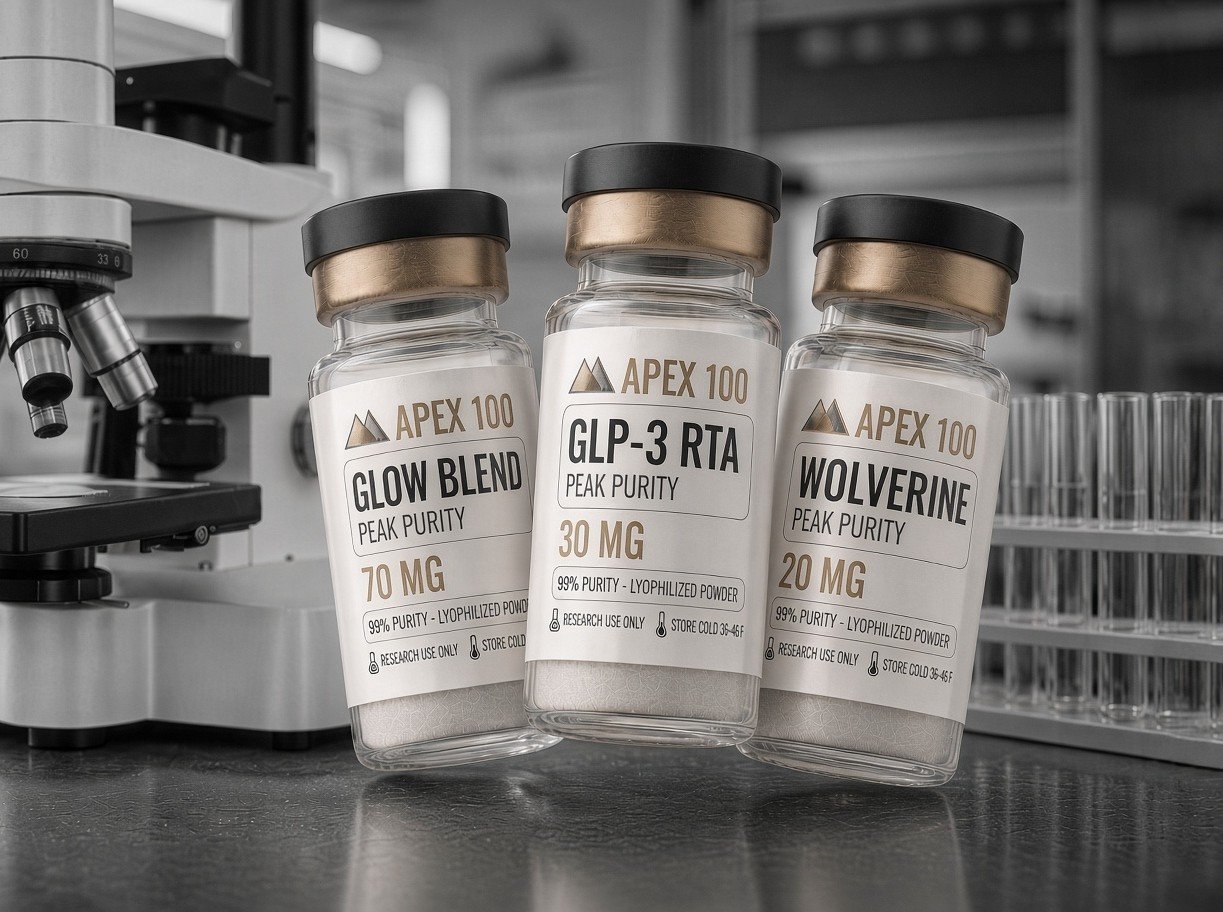
APEX 100 RESEARCH sources materials domestically and verifies each batch through independent third-party laboratories in California, with ?99% HPLC purity and molecular identity confirmed on the COA shipped with every order. Researchers can review batch-specific COAs and testing records before ordering, and the Research Compound Catalog lists available sequences with their documentation.
The gap between a published protocol and a reproducible result usually comes down to material documentation. Laboratories that treat the COA as a primary source rather than a formality catch identity and purity problems before they contaminate a dataset.
For research use only, not only —. Not medical advice.
Frequently Asked Questions
Can research peptides be legally purchased for laboratory use?
Research peptides labeled for research use only are sold to laboratories and institutions for experimental work, not only —. Purchasing is generally lawful when the material is designated for research and handled under institutional rules. Researchers should confirm their institution’s procurement policies and any applicable federal or state requirements before ordering, and verify that the supplier provides batch-specific documentation. The FDA’s 2021 synthetic peptide guidance addresses drug-product development and does not establish general laboratory standards for every research peptide, so suppliers’ claims should be evaluated against analytical data rather than regulatory language.
How does HPLC purity impact the validity of in vitro study results?
HPLC purity determines how much of the sample is the intended peptide versus related impurities, truncation products, or residual solvents. Impurities can carry their own biological activity, so a low-purity sample may produce effects that are wrongly attributed to the target peptide. Researchers describe purity thresholds of 95% or higher for many assays, with 98-99% preferred for sensitive cellular models and receptor-binding work. The COA should state the HPLC method and purity figure for the specific batch, because purity claims without a stated method are difficult to verify independently.
What are the standard protocols for storing and handling research-grade peptides?
Most lyophilized peptides are stored desiccated at -20°C, with some sequences requiring -80°C to limit degradation. Before opening, vials should be equilibrated to room temperature to prevent condensation. Reconstitution typically uses sterile water, phosphate-buffered saline, or dilute acetic acid depending on solubility, and working aliquots should be frozen rather than subjected to repeated freeze-thaw cycles. Light-sensitive sequences need amber vials or foil wrapping. Researchers should record reconstitution date and concentration on each aliquot and follow the supplier’s storage recommendations where provided.
How are synthetic peptides validated for molecular identity in research settings?
Molecular identity is confirmed by mass spectrometry, which compares the observed mass-to-charge ratio against the theoretical mass calculated from the peptide sequence. HPLC retention time provides a secondary check, and amino acid analysis or sequencing can confirm composition when needed. A complete certificate of analysis reports both the HPLC chromatogram and the mass spectrometry result for the specific batch. Researchers performing in-house identity testing should request raw chromatography and spectroscopy files where available, since summary values alone limit independent verification.
What should a certificate of analysis include for a research peptide batch?
A batch-specific COA should identify the peptide sequence, lot number, and date of analysis, and report HPLC purity with the method used, mass spectrometry observed versus theoretical molecular weight, appearance, and water or solvent content where tested. It should name the testing laboratory and be traceable to the specific batch shipped. Without a lot number, a COA cannot be linked to the material in hand. Researchers should compare the reported molecular weight against the sequence they ordered, since a mismatch signals a sequence or documentation error.