Mitigating Peptide Contamination in In Vitro Research
Last Updated: November 15, 2026
Quick Summary
Mitigating peptide contamination in vitro requires identifying the contaminant class first, since synthesis impurities, endotoxin, microbial burden, and cross-contamination each demand a different control. Endotoxin testing with spike recovery and a polymyxin B control distinguishes LPS-driven responses from genuine peptide effects. Documented acceptance criteria and batch records make contamination visible before it distorts assay data.
- Synthesis-derived impurities may provoke immunogenicity, making impurity assessment central to peptide-product safety.
- The 2021 FDA guidance states a new peptide-related impurity at 0.10%-0.5% of drug substance should be characterized.
- Gel-clot LAL is a limit test, while turbidimetric and chromogenic formats are quantitative.
- Polymyxin B binds the lipid A moiety of LPS and neutralizes its TLR4 activity without removing peptide.
- A sterility check detects viable organisms that an endotoxin assay will not.
Table of Contents
- Sources and Types of Peptide Contamination In Vitro
- Peptide Purity and Identity Testing Before Experiments
- Peptide Endotoxin Testing and Lipopolysaccharide Control
- Peptide Aggregation Prevention During Sample Handling
- Controls for Cell-Based Peptide Assays and Assay Interference
- Contamination-Control Workflow for In Vitro Peptide Experiments
- Sourcing Research-Grade Peptides with Documented Purity
- Frequently Asked Questions
Sources and Types of Peptide Contamination In Vitro
Peptide contamination in vitro refers to the introduction of foreign material into a peptide sample or assay system, and it typically falls into four categories: synthesis-derived impurities, endotoxin and lipopolysaccharide (LPS), microbial burden, and cross-contamination from the laboratory environment. Each category behaves differently in cell-based assays, and each demands a different control strategy.
Synthesis-derived impurities are the most studied. The literature describes peptide-related impurities that arise during synthesis and reports that these species may provoke immunogenicity, which is why impurity assessment is treated as central to peptide-product safety (Beyond Efficacy: Ensuring Safety in Peptide Therapeutics).
Endotoxin contamination behaves differently from a synthesis impurity. LPS activates innate immune signaling through Toll-like receptor 4 (TLR4) and the myeloid differentiation primary response 88 (MyD88) pathway, producing immune activation that can be mistaken for a peptide effect.
Cross-contamination sits outside the sample itself. It is investigated as a workspace and handling problem: shared equipment, reused consumables, and non-dedicated pipettes all move material between experiments.
The distinction matters because mitigation is not generic. A review of how low purity skews experimental results illustrates the concrete ways these contaminants distort assay readouts.
Peptide Purity and Identity Testing Before Experiments
Purity and identity testing establishes what is actually in the vial before any in vitro work begins. High-performance liquid chromatography (HPLC) reports the proportion of the main peak relative to total peak area, while mass spectrometry confirms molecular identity against the expected mass.
The two measurements answer different questions. HPLC purity of 99% describes how much of the detected material is the target peptide; it says nothing about whether that target is the correct molecule. A practical guide to interpreting HPLC purity data covers how to read the chromatogram rather than the headline number, including how impurity peaks near the main peak affect the true purity figure.
The 2021 FDA guidance on synthetic peptides states that a new peptide-related impurity present at 0.10%-0.5% of the drug substance should be characterized (FDA Guidance for Industry, Synthetic Peptides). That threshold is a useful reference point for judging whether a certificate of analysis is detailed enough for the intended work.
Identity confirmation deserves equal weight. A deeper walkthrough on confirming peptide molecular identity in the lab explains how mass spectrometry data and retention time together establish that the correct sequence is present.
Peptide Endotoxin Testing and Lipopolysaccharide Control
Peptide endotoxin testing quantifies lipopolysaccharide (LPS) burden in a sample, and it is the single most important control for any assay involving immune cells. The FDA describes in-vitro assays as a means of assessing adaptive immune risk associated with peptide-related impurities (FDA Immunogenicity Assessments in Peptides).
The compendial methods are the limulus amebocyte lysate (LAL) assay, in gel-clot, turbidimetric, and chromogenic formats, and recombinant factor C (rFC) assays.
Testing peptide matrices is harder than testing water. Peptides can interfere with assay reagents through several mechanisms, pH shifts, divalent cation chelation, turbidity, and direct inhibition of the enzymatic cascade, and the sample matrix itself may cause inhibition or enhancement.
A defensible endotoxin testing protocol for peptide matrices includes:
- A standard curve run in the same buffer as the sample, not in water alone
- Spike recovery at a minimum of three endotoxin concentrations spanning the assay range
- A positive product control (PPC) on every sample dilution to detect inhibition or enhancement
- A negative control and a water blank to confirm reagent cleanliness
- Documentation of the maximum valid dilution (MVD) calculated from the endotoxin limit and the sample concentration
Acceptance criteria are typically set in advance, and spike recovery results outside the range defined by the applicable method indicate matrix interference that must be resolved before the result is reported.
Watch out: a clean endotoxin result on an inhibited assay looks identical to a genuinely clean sample.
The evidence base on endotoxin thresholds for in-vitro immune assays is still developing.
Peptide Aggregation Prevention During Sample Handling
Peptide aggregation prevention starts with handling discipline, not with additives. Aggregation is investigated as a stability problem, and a 2023 review describes lyophilization as an approach that can mitigate protein instability in delivery systems (Shi et al., protein and peptide instability review).
The practical controls are unglamorous and effective:
- Aliquot lyophilized peptide into single-use portions on receipt
- Limit freeze-thaw cycles; repeated cycling drives aggregation
- Reconstitute at the working concentration rather than a stock
- Keep reconstituted solutions on ice during use
- Check for visible particulates before adding to any assay
Aggregation and contamination can be confused in practice. A cloudy reconstituted solution may reflect aggregation, not bacterial growth, and the two require opposite responses. Aggregation calls for a handling change; bacterial contamination calls for discarding the batch.
Controls for Cell-Based Peptide Assays and Assay Interference
Controls for cell-based peptide assays determine whether an observed response belongs to the peptide or to something carried alongside it.
A defensible control set includes:
- Vehicle-only control at the matching reconstitution buffer, matched for solvent concentration (dimethyl sulfoxide, acetic acid, or saline) because solvent itself can affect viability
- Endotoxin-spiked control at a known concentration to establish assay sensitivity to LPS
- Spike recovery for any quantitative readout, run in the same matrix as the samples
- Untreated control wells on the same plate, not on a separate plate
- Positive control with a known TLR4 agonist (for example, ultrapure LPS) at a known potency
- A polymyxin B-treated aliquot of the peptide sample, which sequesters LPS and, if the response disappears, implicates endotoxin rather than the peptide
The polymyxin B control is one useful diagnostic step for distinguishing endotoxin-driven responses. Polymyxin B binds the lipid A moiety of LPS and neutralizes its TLR4 activity without removing the peptide.
Distinguishing contamination from a genuine peptide effect comes down to dose-response shape and control behavior. The diagnostic logic is as follows:
- Endotoxin contamination produces a response that is abolished by polymyxin B, tracks with the endotoxin result, and shows a steep dose-response consistent with TLR4 signaling.
- Microbial contamination produces a response that varies between replicates, tracks with handling and storage time, and is often accompanied by turbidity or a change in medium pH.
- Peptide aggregation produces a response that appears at higher concentrations, is reduced by filtration through a 0.22 µm filter, and may show a bell-shaped dose-response as aggregates form.
- Matrix interference produces a response that appears in the vehicle control as well as the peptide wells, or that changes when the sample is diluted in a different buffer.
- A genuine peptide effect produces a response that is stable across replicates, tracks with dose, is not abolished by polymyxin B, and is not present in the vehicle control.
The literature is candid about limits here. Puig et al. (2025) discuss technical limitations in using in-vitro immunogenicity assays as regulatory tools to qualify peptide-related impurities. That finding does not diminish their value as research controls; it clarifies what they can and cannot establish.
Inconsistent results across replicates can trace to handling variables, such as a shared pipette, a repeated freeze-thaw, or a serum lot with elevated endotoxin. Recording the handling history alongside the assay data is what makes that pattern visible.
Contamination-Control Workflow for In Vitro Peptide Experiments
A contamination-control workflow sequences prevention, testing, and documentation into a repeatable process. The sequence below reflects the order in which contamination is best caught, moving from receipt through to acceptance.
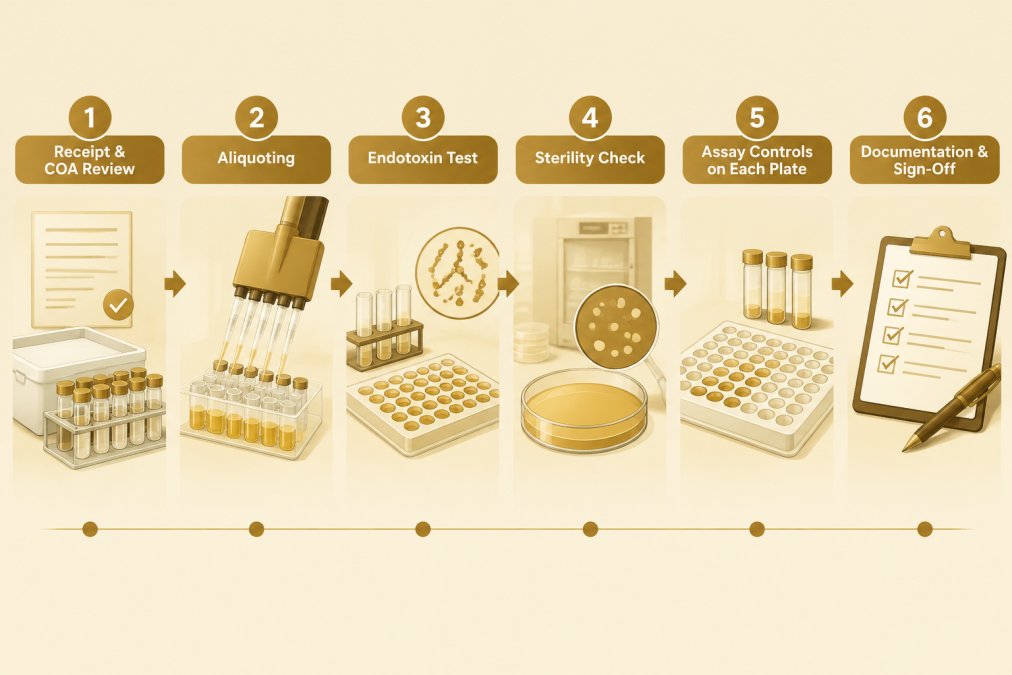
- Review the certificate of analysis on receipt. Confirm HPLC purity, mass spectrometry identity, and endotoxin result against the batch.
- Aliquot before first use. Single-use portions limit freeze-thaw cycling and reduce repeated opening of the stock vial.
- Run endotoxin testing with spike recovery. Include matrix-appropriate recovery controls, not just a standard curve.
- Perform a sterility check. A sterility test detects viable organisms that an endotoxin assay will not.
- Include controls on every plate. Vehicle, spike recovery, and positive controls belong on the same plate as the samples.
- Document acceptance criteria before the run. Define the purity, endotoxin, and recovery thresholds in advance, and record the batch outcome against them.
Step six is the gap most labs leave open. Acceptance criteria written after the data arrive are not criteria; they are rationalization.
The workflow sequences prevention, testing, and documentation from receipt through to acceptance.
| Step | What to do |
|---|---|
| 1 | Review certificate of analysis: HPLC purity, mass spectrometry identity, endotoxin result |
| 2 | Aliquot before first use into single-use portions |
| 3 | Run endotoxin testing with spike recovery controls |
| 4 | Perform a sterility check for viable organisms |
| 5 | Include vehicle, spike recovery, and positive controls on every plate |
| 6 | Document acceptance criteria before the run |
Sourcing Research-Grade Peptides with Documented Purity
Sourcing decisions determine how much of the workflow above is even necessary.
APEX 100 RESEARCH supplies research compounds with ?99% HPLC purity verification and a batch-specific certificate of analysis with every order. The Research Compound Catalog lists the available compounds, and a Peptide Reconstitution Calculator is available for working out reconstitution volumes before an aliquot is prepared.
For laboratories that need to verify documentation before ordering, batch-specific COAs with HPLC and mass spectrometry records are available for review. Researchers who want to act on the sourcing guidance can browse independently tested research compounds with batch-specific certificates.
The evidence base on impurity qualification is still developing, and no supplier documentation substitutes for in-house verification. What documented purity does is narrow the range of variables a study has to control for.
Contamination control in peptide research is a documentation problem as much as a bench problem. Labs that define acceptance criteria, run matrix-appropriate endotoxin testing, and retain verifiable batch records are better positioned to investigate unexplained assay variance.
For research use only, not only —. Not medical advice.
Frequently Asked Questions
How can peptide contamination affect in-vitro study results?
Peptide contamination can alter assay outcomes through several routes. Impurities arising during synthesis may provoke immunogenicity, and FDA materials discuss in-vitro assays for assessing adaptive immune risk from peptide-related impurities. Endotoxin or microbial contamination can activate immune cells in culture, producing cytokine signals unrelated to the peptide itself. Aggregates and residual synthesis impurities may also interfere with cell-based readouts. The result is assay interference that can be mistaken for a biological effect, which is why purity and identity testing before experiments matters.
Does HPLC purity testing rule out endotoxin contamination?
No. HPLC purity testing and peptide purity and identity testing measure the peptide content and detect related impurities, but they do not detect lipopolysaccharide or other pyrogens. Endotoxin testing is a separate assay. The FDA guidance on synthetic peptides addresses peptide-related impurities, and the agency describes in-vitro assays for adaptive immune risk, but neither substitutes for endotoxin testing. Researchers should pair HPLC and mass spectrometry identity data with a validated endotoxin method when the assay uses immune cells or naïve donor peripheral blood.
How can researchers prevent peptide aggregation during in-vitro experiments?
Peptide aggregation prevention centers on storage and handling. Lyophilization is described as an approach that can mitigate protein instability, and aliquoting peptide solutions while avoiding repeated freeze-thaw cycles is a common handling practice. Working at appropriate concentration, avoiding repeated warming, and using fresh aliquots for each experiment reduce the chance of aggregate formation. Because aggregates can scatter light and interfere with assays, visual inspection and consistent handling records help distinguish aggregation from true assay effects.
What controls help identify contamination-related effects in cell-based assays?
Controls for cell-based peptide assays should include a vehicle-only control, a heat-inactivated or otherwise treated peptide control where feasible, and an endotoxin spike recovery check to confirm the assay detects lipopolysaccharide if present. Technical limitations in using in-vitro immunogenicity assays to qualify peptide-related impurities have been discussed in the literature, so controls should be interpreted alongside purity and endotoxin data. Including naïve donor peripheral blood or a defined immune cell source, plus inhibition/enhancement testing, helps separate contamination effects from peptide-specific activity.