How Do You Audit a Peptide Supplier?
Last Updated: November 19, 2026
Quick Summary
To audit peptide suppliers, work through a structured checklist covering legal entity and site, quality system, batch-specific analytical evidence, traceability, and post-qualification monitoring. Verify each certificate of analysis against the vial lot number, the underlying HPLC and mass spectrometry raw data, and the issuing laboratory before qualifying the vendor.
- Documentation typically fails on catalog-level COAs, missing chromatograms, unnamed methods, and in-house testing presented as independent.
- Request a lot-indexed package: batch COA, HPLC chromatogram, MS spectrum, method summaries, and CAPA log.
- Score each audit domain from 1 to 5, weighting analytical evidence at 30% and laboratory independence at 25%.
- Tie re-audit frequency to score movement rather than a fixed calendar, per 2026 industry guidance.
- A certificate describes only the sample tested, so record the sampling plan and test scope with each result.
Table of Contents
- Why Audit Peptide Suppliers Before Qualification
- Building a Peptide Supplier Audit Checklist
- How to Verify a Peptide Supplier COA
- Assessing Third-Party Peptide Testing and Laboratory Independence
- Research Peptide Supplier Questions to Ask During an Audit
- Scoring Supplier Risk and Planning Re-Audits
- Requesting Batch Documentation for a Research Order
- Frequently Asked Questions
Why Audit Peptide Suppliers Before Qualification
Supplier qualification is the process of documenting that a vendor can consistently meet defined specifications before research materials enter a laboratory workflow, and the first step is to audit peptide suppliers against that standard. The 2026 Research Peptide Vendor Report published by BioLongevity Labs places the global synthesis market at $1.9 billion, and it evaluates suppliers specifically against documentation depth, analytical standards, and the rigor of third-party testing practices (BioLongevity Labs vendor report coverage).
Supplier review is most useful when treated as an evidence exercise rather than a relationship exercise, because the failure modes are predictable.
Where Supplier Documentation Typically Fails
Documentation fails in four recurring places:
- Certificates of analysis that describe a catalog number rather than a specific lot
- Purity figures reported without the chromatogram that produced them
- Identity confirmed by a method the supplier will not name
A 2026 industry framework for laboratory and distributor audits notes that effective questionnaires now prioritize quality management systems, batch traceability, and physical verification of facilities and equipment rather than document review alone (research peptide supplier audit questionnaire framework). Paperwork is the entry point, not the conclusion.
Building a Peptide Supplier Audit Checklist
A peptide supplier audit checklist is a structured list of evidence requests, verification steps, and acceptance criteria worked through before qualifying a vendor, reusable across suppliers so scores are comparable.
- Legal entity and site, registered business identity, manufacturing address, and whether synthesis is in-house or brokered
- Quality system, QA and QC roles, deviation handling, change control, and CAPA records
- Analytical evidence, batch-specific certificates, raw data availability, and test method descriptions
- Traceability, lot numbering, chain of custody, and raw material sourcing records
- Post-qualification monitoring, retesting cadence, complaint handling, and re-audit triggers
Documentation and QMS Evidence to Request
Request the following as a single package, indexed by lot number:
- Certificate of analysis for each lot under consideration
- HPLC chromatogram with integration parameters
- Mass spectrometry spectrum with the expected and observed mass
A supplier that reviews batch-specific COAs, HPLC purity results, and mass spec identity checks as routine output will produce this package without friction (certificate of analysis records and testing documentation). A supplier that produces it slowly, or produces a redacted version, has answered the question anyway.
How to Verify a Peptide Supplier COA
Verification means matching the certificate to the physical lot, the underlying instrument data, and the issuing laboratory. Lot match and method disclosure do not by themselves prove that a report is genuine, current, and not recycled, which is where authentication comes in.
- Lot match. The lot number on the COA must match the vial label, packing slip, and supplier records. A certificate referencing a catalog number cannot be tied to the material in hand.
- Method disclosure. The COA should name the test method, column type, detection wavelength, and gradient for HPLC, and the ionization mode and instrument class for mass spectrometry.
- Data provenance. The report should state which laboratory generated the data and whether it is internal or independent.
A certificate that lists purity without a chromatogram is an assertion; one with a chromatogram, an integration table, and a named testing laboratory is evidence. A detailed guide on how to read a certificate of analysis covers integration parameters and what a well-formed report contains.
Authenticating the Report Itself
The second layer is data integrity. A well-formed certificate carries an identifier that can be checked independently, a report number, an issue date, and a laboratory contact that resolves to a real person or department. The practical checks are:
- Report identifier. The certificate should carry a unique report number and issue date. A report with no identifier, or one repeating across unrelated lots, is a recycled document.
- Laboratory contact verification. The named laboratory should be reachable at a published address and phone number and should confirm on request that it issued the report.
- Raw data availability. The supplier should produce the underlying chromatography and spectroscopy files on request; a certificate that cannot be traced to raw data is a summary, not a record.
A common pattern is a certificate that is genuine but stale, issued for an earlier lot and reused because the supplier did not commission new testing.
Watch out: a certificate that passes lot match and method disclosure can still fail authentication if the report number cannot be confirmed with the issuing laboratory, so the contact check should be completed before the material enters a study.
Interpreting HPLC Purity and Mass Spectrometry Data
HPLC purity is the percentage area of the target peak relative to total integrated peak area at a stated wavelength.
- Peak shape, fronting or tailing suggests column or sample issues
- Shoulders, an unresolved shoulder inflates apparent purity
- Integration baseline, a manually raised baseline removes small impurities from the calculation
Mass spectrometry answers a different question: it confirms molecular identity by comparing observed mass-to-charge values against the theoretical mass of the expected sequence. Sequence confirmation by MS/MS fragmentation goes further, showing the peptide backbone fragments as predicted.
What the tests do not establish matters as much as what they do.
Assessing Third-Party Peptide Testing and Laboratory Independence
Third-party peptide testing is analytical work performed by a laboratory with no ownership or financial relationship to the supplier. Independence is the operative word and is verifiable, but independence alone does not make a result representative, and the limits of what a single tested sample can establish are where most reviews stop short.
- The name and address of the testing laboratory
- Accreditation status and the scope of that accreditation
- Whether the laboratory receives blinded samples
Current industry guidance stresses that independent, lab-verified data is necessary to counter forged certificates, and that HPLC and MS records must be batch-specific and generated by an independent third party rather than the supplier’s internal laboratory (data-driven vendor review guidance). What independent third-party laboratory testing actually means, and where the boundary between “sent out” and “independent” sits, is set out in a separate explainer on independent laboratory testing.
What Accreditation Scope Does and Does Not Cover
An accreditation certificate confirms that a laboratory operates a quality system for the methods listed in its scope. It does not confirm that every method a supplier relies on falls inside that scope, nor that the specific report in hand was generated under accredited conditions. The practical check is to compare the methods named on the COA, reversed-phase HPLC, electrospray ionization mass spectrometry, amino acid analysis, against the laboratory’s published scope.
Sampling Bias and What a Single Tested Sample Establishes
A certificate describes the sample that was tested, not the lot that was shipped. Where the supplier selects the sample, the result reflects that selection. The literature on pharmaceutical sampling describes the risk plainly: a homogeneous-looking vial can mask lot-to-lot variation, and a single passing sample does not establish that every vial in the lot would pass. The practical implications for an audit are:
- Sample selection. Ask whether the tested sample was drawn by the supplier, the laboratory, or a blinded third party. Supplier-drawn samples are the weakest evidence.
- Sampling plan. Ask how many vials per lot are sampled and whether sampling is random or convenience-based. A single vial from a large lot is a point estimate, not a lot profile.
- Retained samples. Ask whether the supplier retains samples from each lot and whether those can be retested independently.
A common pattern is a supplier that commissions full testing on a qualification lot and reduced testing on production lots. The audit should establish which tests are run on every lot and which on a sampling basis, because the certificate for a production lot may cover less than the certificate used to qualify the supplier.
What Independent Testing Does Not Establish
Independent testing confirms the identity and purity of the sample tested. It does not confirm the manufacturing location, raw-material provenance, change-control history, or whether the material in the shipment is the material that was tested.
Watch out: a certificate from an accredited laboratory can still describe a sample the supplier selected, so the sampling plan and the test scope should be recorded alongside the result before the lot is accepted.
Research Peptide Supplier Questions to Ask During an Audit
Questions should be specific enough that a vague answer is itself informative. The following set covers the gaps that documentation alone does not close.
On manufacturing and traceability
- Where is the peptide synthesized, and is any step subcontracted?
- How are raw materials qualified, and can sourcing records be produced for a given lot?
- What is the lot numbering scheme, and how does it link to synthesis records?
On analytical scope
- Which tests are run on every lot, and which are run on a sampling basis?
- What are the acceptance criteria for identity, purity, and assay?
- Can raw chromatography and spectroscopy files be supplied?
On quality events
- How many deviations were opened in the last year, and what were the root causes?
- What triggers a change control review, and are customers notified?
- What is the policy when a batch fails acceptance criteria?
On monitoring
- How often are retained samples retested?
- What is the complaint intake and investigation process?
- Will the supplier accept an on-site or remote audit, and on what notice?
Scoring Supplier Risk and Planning Re-Audits
A risk score converts audit findings into a decision. Score each domain from 1 to 5, weight by criticality, and total. Analytical evidence and traceability should carry the heaviest weight, because those are the domains where a failure reaches the bench.
| Domain | Weight | Score 1 (High Risk) | Score 3 (Conditional) | Score 5 (Low Risk) |
|---|---|---|---|---|
| Analytical evidence | 30% | No lot-specific COA | COA without raw data | Lot COA plus raw files |
| Laboratory independence | 25% | Internal testing only | Mixed internal and external | Accredited external lab |
| Traceability | 20% | No lot linkage | Partial records | Full chain of custody |
| Quality system | 15% | No CAPA process | Informal process | Documented CAPA log |
| Monitoring | 10% | No retest policy | Ad hoc retesting | Scheduled retesting |
Weight
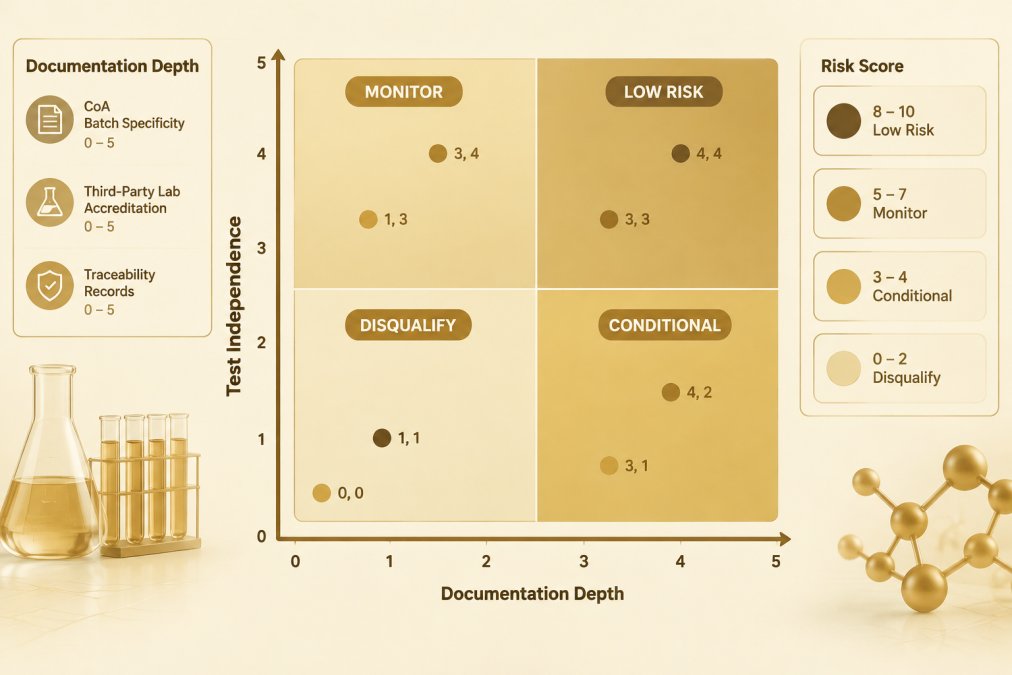
Industry guidance for 2026 recommends tying audit frequency to score movement rather than a fixed calendar: a supplier whose annual score trends downward should trigger a focused verification visit (supplier annual scoring and tiering guidance). A structured method for evaluating batch consistency across successive lots supports that monitoring cycle, and a step-by-step approach to evaluating batch consistency covers the comparison work in detail.
Requesting Batch Documentation for a Research Order
Documentation requests should be attached to the order itself, not raised afterward. Specify in the purchase terms that the shipment must include a lot-specific certificate, the corresponding chromatogram and spectrum, and the name of the testing laboratory.
- Confirm the lot number before shipment and request its COA in advance
- Verify the COA lot matches the vial label on arrival
- Retain the raw data files alongside the sample records
- Log the receipt against the audit file for the next scoring cycle
Watch out: accepting a certificate that references a catalog number instead of a lot number defeats the entire verification chain, because the document can no longer be tied to the material in hand. Laboratories that have completed an audit and are moving to a new vendor can follow guidance on switching peptide suppliers without disrupting research to sequence the transition. For orders where documentation is the deciding factor, the research compound catalog shows the batch-level records supplied with each lot.
For research use only, not only —. Not medical advice.
The recurring obstacle in peptide sourcing is not a shortage of suppliers but a shortage of verifiable evidence, and the audit exists to separate the two.
Frequently Asked Questions
What should a peptide supplier audit include?
A supplier audit should cover quality management system documentation, batch-specific certificates of analysis, independent laboratory accreditation and test scope, lot traceability from raw material to finished vial, deviation and CAPA records, and change-control procedures. Audit guidance generally emphasises physical verification of facilities and equipment alongside document review, and third-party compliance and vendor management are commonly treated as core audit topics. A remote document review can screen suppliers, but on-site verification is what confirms that stated practices match actual operations.
How can a buyer verify a peptide supplier’s Certificate of Analysis?
Verification requires confirming that the CoA is batch-specific, that the lot number matches the vial received, and that HPLC and mass spectrometry records were generated by an independent third party rather than the supplier’s internal lab. Independent, lab-verified data is widely regarded as a more reliable check against forged certificates than supplier-provided documents alone. Researchers should request raw chromatography and spectroscopy files, confirm the testing laboratory’s accreditation, and contact that laboratory directly to authenticate the report before accepting a batch.
How can a buyer assess third-party testing for peptides?
Assess the testing laboratory rather than the supplier’s description of it. Confirm the lab’s identity, its accreditation status, and the analytical methods in scope: reverse-phase HPLC for purity, LC-MS or mass spectrometry for identity and sequence confirmation, and where relevant, assay and residual solvent testing. Documentation depth and analytical standards are commonly used criteria for evaluating suppliers, and certification claims are best verified against the issuing body rather than accepted on self-attestation. A laboratory the supplier owns is not an independent third party.
How can peptide batch traceability be evaluated?
Traceability is evaluated by requesting the full chain for a specific lot: raw material source, synthesis or manufacturing site, date of production, analytical testing records, and chain-of-custody documentation for samples sent to the testing laboratory. The supplier should be able to connect a vial’s lot number to those records without gaps. Where a supplier cannot map a lot back to its manufacturing site, or where change-control and deviation records are absent, the traceability chain is incomplete and the batch should be treated as unverified pending further evidence.