How to Switch Peptide Suppliers Without Disrupting Research
Last Updated: October 25, 2026
Quick Summary
To switch peptide suppliers without disrupting research, treat the change as a change-control event: qualify the new vendor against a written checklist, verify batch-specific COAs and identity data, and run incoming and outgoing supply in parallel until the new lot is assayed and accepted. Retiring the outgoing supplier before the incoming lot clears in-house verification converts a controlled change into an unplanned supply disruption.
- A research peptide supplier checklist converts an informal vendor preference into an auditable qualification decision.
- A complete COA reports purity by HPLC, identity by mass spectrometry, and a named, contactable third-party laboratory.
- Normalize every quote to the same order quantity, shipping basis, and testing obligation before scoring suppliers.
- Size contingency stock from the incoming supplier’s lead time plus assay duration plus a buffer for a failed first lot.
- Maintain a qualified backup vendor record with documentation status, lead time, and a current COA on file.
Table of Contents
- Why a Supplier Transition Plan Matters for Research Continuity
- Step 1: Build a Research Peptide Supplier Checklist
- Step 2: Read a Peptide Supplier Certificate of Analysis
- Step 3: How to Verify Peptide Purity and Identity
- Step 4: Peptide Supplier Red Flags to Catch Before You Commit
- Step 5: Compare Suppliers on Total Cost and Terms
- Step 6: Execute the Transition with Contingency Stock
- Step 7: Review APEX 100 RESEARCH Documentation Before Ordering
- Frequently Asked Questions
Why a Supplier Transition Plan Matters for Research Continuity
How to switch peptide suppliers is a documentation problem before it is a purchasing problem. The framework below reflects the stance that supplier transition is a change-control event rather than a shopping decision. (Source: FDA guidance on analytical procedures and methods validation)
The central risk is not a failed delivery. It is a silent shift in the reference material itself. A new lot with a different impurity profile can alter assay behavior without any warning on the invoice.
That is why the process below runs in seven stages. Each stage produces a record. The records, not the relationship, carry the study forward.
Step 1: Build a Research Peptide Supplier Checklist
A research peptide supplier checklist is a written set of qualification criteria that a vendor must satisfy before any order is placed. The checklist converts an informal preference into an auditable decision.
Six criteria matter most:
- Documented synthesis and purification method
- Batch-specific COA availability before purchase
- Named third-party testing laboratory
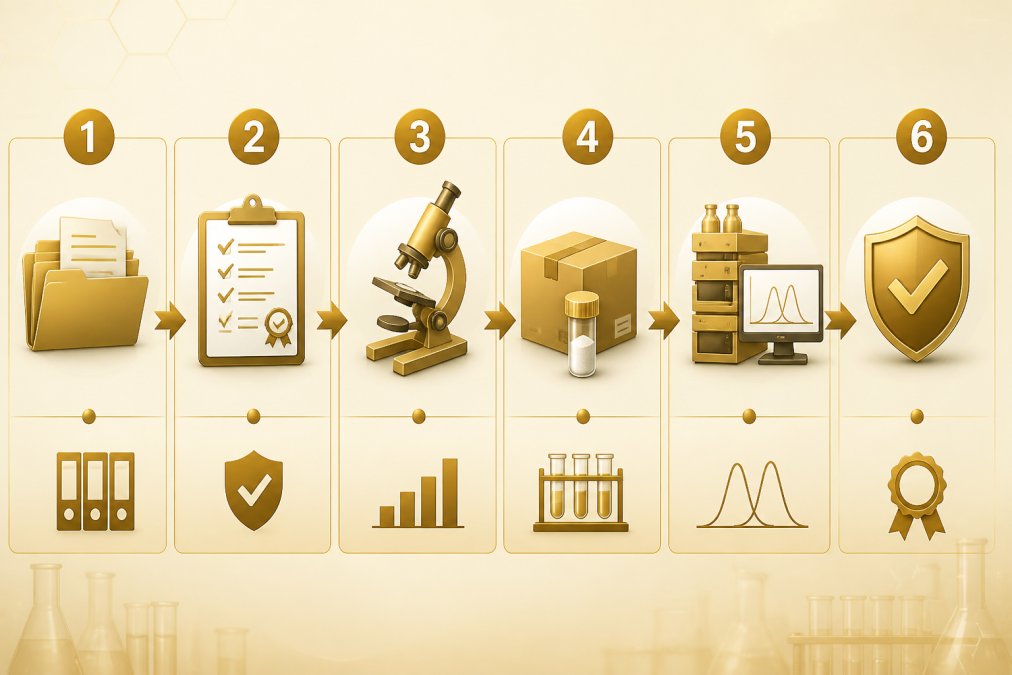
Qualification and Verification Before Switching
Qualification is the evidence-gathering phase; verification is the confirmation that the evidence holds. Researchers describe the two as distinct because a vendor can supply impressive paperwork that fails independent confirmation.
Verification steps include contacting the named testing laboratory, confirming the lot number on the COA matches the lot shipped, and checking that identity data accompanies purity data. A supplier that supplies purity figures without mass spectrometry identity confirmation has not completed the file.
Step 2: Read a Peptide Supplier Certificate of Analysis
A peptide supplier certificate of analysis is a batch-specific document reporting the analytical results for one lot, including purity by HPLC, identity by mass spectrometry, and the testing laboratory responsible.
Four elements deserve scrutiny:
- Lot number: must match the vial label and the shipping documentation
- Method: HPLC gradient and wavelength should be stated
- Identity confirmation: mass spectrometry results, not a purity figure alone
FDA guidance on analytical procedures and methods validation describes the general expectations for method documentation that research buyers can use as a reference point when judging whether a COA is complete.
Batch-specific COA examples and HPLC purity records are available for review.
Batch Documentation and Change Control
Change control is the practice of recording what changed between lots and assessing whether the change affects the study. When a supplier transition occurs, the incoming lot becomes a new reference material.
A practical change-control record carries the previous lot number, the incoming lot number, the assay date, and a side-by-side comparison of purity and identity results. If the incoming lot has not been assayed in-house, the record should state that explicitly.
Step 3: How to Verify Peptide Purity and Identity
Verifying peptide purity means confirming the percentage of target peptide in a lot by HPLC, while verifying identity means confirming molecular mass by mass spectrometry. The two checks answer different questions and neither substitutes for the other.
In practice, the verification sequence runs as follows:
- Request the batch COA before ordering
- Confirm the lot number against the shipped vial
- Review the HPLC chromatogram for peak shape and impurity profile
- Review the mass spectrometry result against the expected molecular weight
- Repeat an in-house assay on receipt where the study requires it
A deeper walkthrough of chromatogram interpretation and identity confirmation is set out in How to Verify Peptide Purity: HPLC, MS & COA.
Third-Party Testing and Raw Data Access
Third-party testing is the analysis of a lot by a laboratory independent of the supplier.
The question researchers ask most often is whether raw chromatography and spectroscopy files are available, or only the summary printed on the COA.
ICH harmonised guideline Q2(R2) on analytical validation_Guideline_2023_1130.pdf) sets out the validation concepts that underpin how purity and identity results are generated, which helps buyers judge whether a reported method is credible.
A fuller treatment of independent laboratory arrangements appears in Independent Lab Testing for Peptides: A 2026 Guide.
Step 4: Peptide Supplier Red Flags to Catch Before You Commit
Peptide supplier red flags are warning signs that a vendor cannot support documented, reproducible research. They are easier to catch before commitment than after.
The most common signals include:
- COAs that are not batch-specific, or that carry no lot number
- Purity claims stated without mass spectrometry identity data
- No named testing laboratory, or a laboratory that cannot be contacted
Watch out: a COA that reports a purity figure but omits the chromatogram removes the buyer’s ability to assess impurity profile, and that gap tends to surface only when an assay behaves unexpectedly.
Buyer requirements, prohibited uses, and documentation standards are set out on the Compliance page.
Step 5: Compare Suppliers on Total Cost and Terms
Total cost comparison means modeling the landed cost of a supply arrangement rather than comparing unit line items.
A like-for-like comparison requires the buyer to normalize every quote to the same basis before scoring. The following cost components should be recorded for each candidate supplier:
- Unit price at the study’s actual order quantity, not the headline price at a quantity the laboratory will never order
- Minimum order quantity (MOQ), and the carrying cost of any stock above the study’s needs
- Shipping and handling, including cold-chain or expedited terms where the compound requires them
A common pattern is that the lowest unit price carries the highest MOQ and the weakest replacement terms, so the apparent saving disappears once carrying cost and failure risk are included.
The scorecard below is a working template. Score each criterion from 1 to 5 and weight it according to study sensitivity.
| Criterion | What to Record | Weight |
|---|---|---|
| Documentation | Batch-specific COA, lot traceability | High |
| Identity data | Mass spectrometry results supplied | High |
| Raw data access | Chromatography and spectroscopy files | Medium |
| Landed cost | Unit price at study quantity plus shipping, testing, and MOQ carrying cost | High |
| Lead time | Quoted turnaround and reliability | Medium |
| Minimum order quantity | Flexibility for small laboratories | Medium |
| Replacement terms | Process if a lot fails specification | High |
| Payment terms | Prepayment versus net terms | Low |
| Communication | Named technical contact | Low |
Normalize every quote to the same order quantity, the same shipping basis, and the same testing obligation before scoring. A scorecard built on mismatched bases ranks suppliers on presentation rather than on landed cost.
Pricing for research compounds depends on quantity, specification, and delivery terms, so current figures should be requested directly rather than inferred from a comparison table. The comparison should record the basis of each quote, quantity, shipping terms, and testing obligations, so the scorecard remains auditable when the transition is reviewed.
Step 6: Execute the Transition with Contingency Stock
Executing a supplier transition means running the incoming and outgoing supply in parallel until the new lot has been assayed and accepted. Contingency stock is the buffer that makes parallel running possible, and change-control documentation is what makes the transition auditable after the fact.
A workable sequence:
- Place a qualification order with the incoming supplier
- Assay the incoming lot against the current reference material
- Hold existing stock to cover the assay period
The most common mistake is retiring the outgoing supplier before the incoming lot has cleared in-house verification. That converts a controlled change into an unplanned supply disruption.
Change-Control Documentation for the Transition
Change control is the practice of recording what changed between lots and assessing whether the change affects the study. When a supplier transition occurs, the incoming lot becomes a new reference material, and the transition record should capture the reason for the change, the assessment of product and process differences, and the acceptance decision.
A practical change-control record carries:
- The reason for the supplier change, discontinuation, quality failure, lead-time risk, or cost
- The outgoing and incoming supplier identities and lot numbers
- A side-by-side comparison of purity and identity results for the two lots
If the incoming lot has not been assayed in-house, the record should state that explicitly rather than implying equivalence. Researchers describe the unstated assumption of equivalence as the most common documentation failure in a supplier transition.
Sizing Contingency Stock
Contingency stock is sized from lead time and assay duration, not from a fixed rule. A common pattern is to hold enough outgoing-supplier stock to cover the incoming supplier’s quoted lead time plus the in-house assay period plus a buffer for a failed first lot. Where the study cannot tolerate interruption, the buffer should assume one rejected lot and a reship.
A transition that retires the outgoing supplier before the incoming lot clears verification is not a controlled change, it is an unplanned supply disruption with paperwork attached.
Fallback and Backup Vendor Planning
A backup vendor record should be maintained for every critical compound, with a qualified alternate supplier identified before it is needed. The record should carry the alternate’s documentation status, lead time, and a current COA on file, so that a second transition can be executed without repeating the full qualification cycle. Supply-chain resilience literature treats this as a standard dual-sourcing practice, and the same logic applies to research peptide sourcing.
Step 7: Review APEX 100 RESEARCH Documentation Before Ordering
APEX 100 RESEARCH supplies research compounds with a batch-specific Certificate of Analysis on every order, reporting ?99% HPLC purity and molecular identity confirmed by mass spectrometry.
The catalog covers compounds including GLP-3 RTA, GLP-2 TZA, the Wolverine Blend (BPC-157 + TB-500), and the GHK-Cu blends, alongside the wider Research Compound Catalog.
Questions about compound specifications, certificates of analysis, orders, or shipping can be directed through customer support.
A transition that preserves study continuity depends on records, not on relationships.
For research use only, not only —. Not medical advice.
Frequently Asked Questions
How do researchers evaluate a peptide supplier before switching?
Researchers evaluate a peptide supplier by requesting batch-specific documentation before any order is placed. The review should cover the certificate of analysis, HPLC and mass spectrometry data, third-party testing records, and the supplier’s stated quality standards. A practical step is to request a small qualification sample and run it through the laboratory’s own identity assay alongside the incumbent supplier’s material. This side-by-side comparison reveals whether the new vendor meets the same specifications and reduces the risk of a failed transition.
What should a peptide supplier certificate of analysis include?
A peptide supplier certificate of analysis should identify the batch number, the compound name, the testing laboratory, and the analytical methods used. It should report HPLC purity as a percentage, confirm molecular identity by mass spectrometry, and state the date of analysis. Documentation that omits the batch number or the testing lab is difficult to audit. Researchers should confirm that the COA matches the specific lot being shipped, not a generic specification sheet, because batch-to-batch variation is a documented concern in research peptide sourcing.
What are red flags when choosing a peptide supplier?
Common peptide supplier red flags include refusal to share raw chromatography data, COAs that lack a batch number or testing laboratory, and purity claims that cannot be traced to a third-party report. Inconsistent product specifications across orders, vague shipping terms, and no documented replacement policy for failed batches are also warning signs. Researchers should treat any vendor that cannot answer technical questions about its testing process as a qualification risk and keep the incumbent supplier active until the new one clears verification.
How can researchers maintain batch traceability when changing suppliers?
Batch traceability is maintained by recording the new supplier’s lot number, COA date, and testing laboratory in the laboratory’s change-control log before the first experimental use. A side-by-side assay against the incumbent batch creates a documented bridge between the two sources. Researchers should retain samples from both suppliers and note the transition date in study records so that any later analytical discrepancy can be traced to a specific batch. This documentation practice is consistent with good laboratory record-keeping standards.