7 Lab Standards for Peptide Synthesis Every Researcher Needs
Last Updated: November 14, 2026
Quick Summary
Lab standards for peptide synthesis govern the measurable properties of a finished batch: purity, molecular identity, documentation, and storage. Each standard pairs a test method with an acceptance limit, because a purity percentage without its method is not reproducible. Identity claims are strongest when two independent methods agree.
- Reversed-phase HPLC at 214 nm reports more impurity than detection at 280 nm on the same lot.
- Mass spectrometry alone cannot distinguish isomers or confirm stereochemistry, so orthogonal confirmation is needed.
- A Certificate of Analysis should attach the chromatogram and state the method and testing laboratory reference.
- The seven-step workflow gates each stage, and out-of-specification results require documented corrective action, not a re-run.
- Independent verification requires that buyers can see raw data and identify the testing laboratory.
Table of Contents
- What Lab Standards for Peptide Synthesis Actually Govern
- Peptide Purity Testing: Reading HPLC Data Beyond the Headline Number
- Peptide Identity Testing: Mass Spectrometry and the Limits of a Single Method
- What a Peptide Certificate of Analysis Should Document
- Peptide Reference Standards and the Case for Independent Verification
- A Step-by-Step Quality Control Workflow for the Laboratory
- Sourcing Research Compounds Against These Standards
- Frequently Asked Questions
What Lab Standards for Peptide Synthesis Actually Govern
Lab standards for peptide synthesis govern the measurable properties of a finished batch: how pure it is, whether its molecular identity matches the intended sequence, how it was documented, and how it was stored.
The distinction matters more than most protocols admit. Analytical work on synthetic peptide reference standards, described by McCarthy et al. (2023) in reference standards to support quality of synthetic peptide, treats vialing, lyophilization, analytical testing, and stability studies as one linked chain rather than separate steps.
Below, each standard is broken into what it measures, how to check it, and where the evidence base is thin. The first task is separating three bars that get conflated constantly.
Research-Grade, Analytical Reference, and GMP: Three Different Bars
The three are not interchangeable. A research-grade batch passing a 95% purity threshold says nothing about suitability as a calibrant, and a reference standard characterized across laboratories is not automatically a manufacturing-grade lot.
The practical rule: match the standard to the use. Identity screening needs one bar, quantitative assay work a higher one, and anything destined for a regulatory submission the highest.
Peptide Purity Testing: Reading HPLC Data Beyond the Headline Number
Peptide purity testing by reversed-phase HPLC separates components by hydrophobicity and reports the main peak as a percentage of total peak area. That single number hides almost everything a reviewer needs.
Three method details change the interpretation:
- Wavelength. Absorbance at 214 nm captures the peptide backbone and reports more impurity than 280 nm, which sees only aromatic residues. A lot reported at 98% by 214 nm and 99% by 280 nm is the same lot described two ways.
- Integration parameters. A shallow threshold counts small shoulders as impurities; an aggressive one hides them. Slope sensitivity, peak width, and baseline handling should be fixed in the method and not adjusted per batch.
- Gradient and column. Different methods give different profiles for the same lot. Column chemistry, particle size, pore size, and gradient slope all shift retention and resolution.
A chromatogram showing one clean peak and one showing a peak plus four unresolved shoulders can both report 98%. The impurity profile, not the headline percentage, is the real specification.
Setting and Interpreting Acceptance Criteria
A release specification is a decision rule written before the batch is tested.
Several attributes are commonly specified together rather than in isolation:
- Purity by HPLC as main-peak area percent, with the chromatogram retained.
- Identity by mass spectrometry, with observed mass reported against theoretical and a stated mass tolerance.
- Water content by Karl Fischer titration, since residual moisture affects weighed quantities and stability.
The 2025 review by Elsayed et al. on regulatory guidelines for the analysis of therapeutic peptides surveys the analysis, stability testing, and quality control expectations that inform these criteria.
Researchers who want to interpret peak shape and shoulder integration in detail can work through the step-by-step chromatogram walkthrough.
Peptide Identity Testing: Mass Spectrometry and the Limits of a Single Method
Peptide identity testing confirms that the synthesized molecule matches the intended sequence, and mass spectrometry is the standard first method.
That limit is worth stating plainly: mass alone cannot distinguish isomers, resolve certain isobaric deletions and substitutions, or confirm stereochemistry.
Orthogonal confirmation closes the gap:
- Tandem mass spectrometry fragments the peptide and reads the sequence from fragment ions.
- Amino acid analysis quantifies composition after hydrolysis.
- Peptide mapping compares enzymatic digests against a reference.
A single mass confirmation is a starting point; two independent methods agreeing is a defensible identity claim. The guide to confirming molecular identity covers how orthogonal methods are combined.
What a Peptide Certificate of Analysis Should Document
A peptide Certificate of Analysis is the batch-specific record tying a lot number to its analytical results, and it should let an independent reviewer reconstruct how the material was tested. A document listing only a purity percentage fails that test.
At minimum, a COA should carry:
- Lot or batch identifier and the date of analysis
- The analytical method used, including column and detection wavelength
- HPLC purity result with the chromatogram attached
The 2023 reference-standard work by McCarthy et al. describes analytical strategies built on this kind of multi-part characterization rather than a single headline figure.
APEX 100 RESEARCH includes a batch-specific COA with every order, and the full COA records with HPLC purity results and mass spec identity checks are available for review before purchase. For a field-by-field explanation of each entry, the COA reading guide covers the document line by line.
Peptide Reference Standards and the Case for Independent Verification
Peptide reference standards are characterized materials used to calibrate instruments and anchor comparisons between batches. Their value depends entirely on how they were characterized, and self-reported characterization is the weakest form.
Independent verification means a laboratory with no commercial stake performs the testing, the separation that makes data auditable.
Two questions separate real verification from a rubber stamp:
- Can the buyer see the raw data, not just the summary?
- Can the buyer identify the testing laboratory and its report reference?
If either answer is no, the verification claim is unverifiable. Some suppliers state that materials are sourced in the USA and tested by independent third-party laboratories in California; buyers should confirm these claims against the batch documentation.
A Step-by-Step Quality Control Workflow for the Laboratory
Quality control for incoming peptides follows a fixed sequence, and each step gates the next.
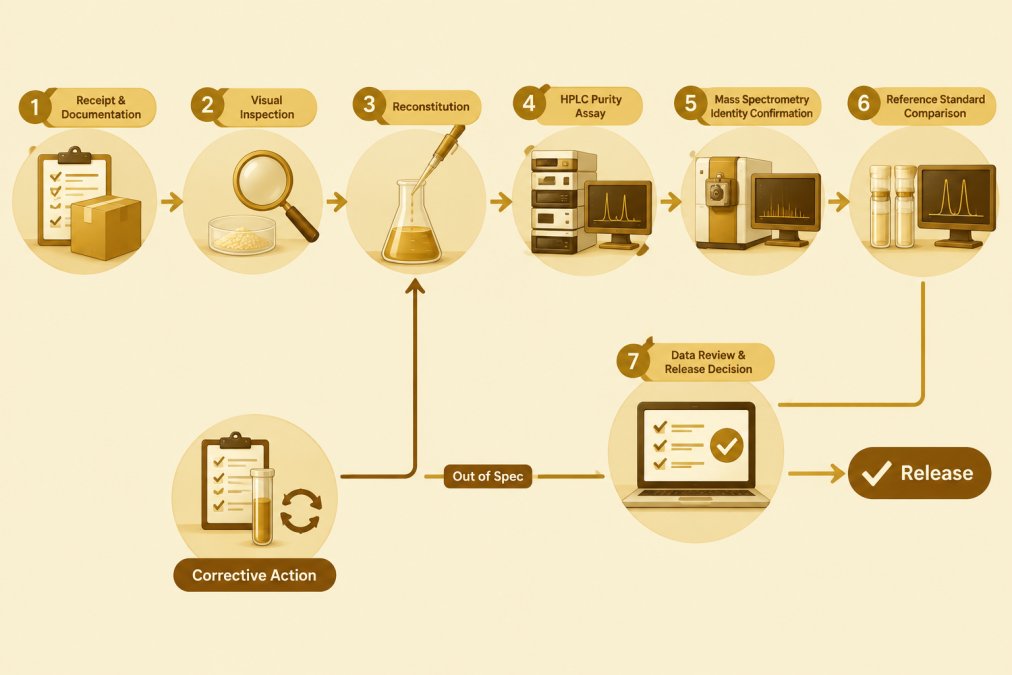
Step 1: Review documentation on receipt. Confirm the lot number on the COA matches the vial.
Step 2: Inspect the material visually. Record appearance, any cake collapse after lyophilization, and vial integrity.
Step 5: Confirm identity by mass spectrometry. Compare observed mass against theoretical and record the delta against the stated tolerance.
Step 7: Review data and release. A second reviewer signs off.
Documentation and Data Integrity Controls
The workflow above only holds if the records behind it are controlled. Laboratory quality systems commonly require each step to produce a contemporaneous, attributable record, who did it, when, with what equipment, and against which method, with changes traceable.
- Batch and test records that link the lot number to every analytical result and to the reviewer who released it.
- Deviation records that capture what went wrong, the immediate containment, the root cause, and the corrective and preventive action taken.
- Change control for any change to method, equipment, or supplier, so that a specification is not quietly altered between batches.
- Equipment qualification and calibration records for balances, pipettes, HPLC systems, and mass spectrometers, since an uncalibrated instrument undermines every result it produces.
Watch out: an out-of-specification result re-injected or re-integrated until it passes, without a documented investigation, is the most common data-integrity finding in analytical laboratories, the corrective action has to be recorded before the re-run.
Troubleshooting Common Failures
A practical workflow also anticipates recurring failures. The causes and corrective steps below reflect general analytical practice rather than a validated standard:
- A purity result lower than expected. Common causes include a different gradient or column than the releasing method, sample overloading, or a degraded lot. Corrective action is to re-run against the stated method and compare the impurity profile, not just the percentage.
- A mass that does not match. Causes include the wrong counterion, residual water or salt, or a sequence error. Corrective action is to confirm the expected salt form and re-check against theoretical mass for that form.
- Poor peak shape or shifting retention. Causes include column aging, mobile-phase preparation error, or temperature drift. Corrective action is to run a system suitability check before accepting the result.
- Failed reconstitution or visible particulates. Causes include incomplete dissolution or aggregation. Corrective action is to record the observation and investigate before use.
The 2025 review by Elsayed et al. on regulatory guidelines for the analysis of therapeutic peptides covers the analysis, stability testing, and quality control expectations that underpin this sequence. Note the honest limit: that review does not report sample sizes or quantitative benchmarks, so the workflow and troubleshooting above reflect general analytical practice rather than a validated standard.
| Standard | What It Measures | Typical Method | Documentation Required |
|---|---|---|---|
| Purity | Main peak as % of total area | Reversed-phase HPLC | Chromatogram plus method |
| Identity | Mass matches intended sequence | Mass spectrometry | Observed vs theoretical mass |
| Sequence confirmation | Fragment pattern matches sequence | Tandem MS or peptide mapping | Fragment or digest data |
| Composition | Amino acid ratios after hydrolysis | Amino acid analysis | Quantitative composition table |
| Water content | Residual moisture | Karl Fischer titration | Titration record |
| Stability | Integrity over time and conditions | Scheduled re-testing | Stability study record |
| Batch consistency | Lot-to-lot agreement | Side-by-side HPLC vs standard | Comparison report |
Sourcing Research Compounds Against These Standards
Sourcing comes down to whether a supplier will show the underlying data.
A short due-diligence checklist before any order:
- Does the COA name the testing laboratory and a report reference?
- Is the chromatogram attached, with method and wavelength stated?
- Is the mass spectrometry result shown against theoretical mass?
- Are storage conditions and handling guidance specified?
APEX 100 RESEARCH verifies every batch through independent third-party laboratories in California and confirms ?99% HPLC purity and molecular identity on a batch-specific COA. The testing standards behind each batch set out how that verification is documented. The research compound catalog lists the available materials, and the peptide reconstitution calculator supports accurate preparation once material is in hand.
The gap between a documented compound and an undocumented one is not visible in the vial. It is visible in the paperwork, and that is where the evaluation belongs.
The recurring problem in peptide sourcing is not the absence of standards but the absence of evidence that they were applied.
For research use only, not only —. Not medical advice.
Frequently Asked Questions
What is the difference between peptide purity and peptide identity?
Purity describes how much of the material in a sample is the target peptide rather than related impurities, and is usually reported as a percentage from reversed-phase HPLC. Identity confirms that the target peptide is actually present, typically through mass spectrometry matching the observed mass to the theoretical mass of the intended sequence. A sample can be 99% pure by HPLC area and still be the wrong sequence, which is why McCarthy et al. (2023) describe reference-standard programs that pair purity testing with orthogonal characterization. Both measurements are needed before a batch is treated as verified.
What information should a peptide Certificate of Analysis include?
A usable peptide Certificate of Analysis should identify the batch and lot number, the peptide sequence and molecular formula, the theoretical and observed mass, the HPLC method and purity result, the mass spectrometry method used for identity confirmation, storage conditions, and the date of testing. It should also name the laboratory that performed the testing. McCarthy et al. (2023) describe reference-standard production that includes vialing, lyophilization, analytical testing, and stability studies, and a COA that omits method detail gives the receiving laboratory nothing to audit against.
What are peptide reference standards used for?
Peptide reference standards provide a characterized comparator against which a new batch is measured. They support method development and validation, let a laboratory check that an analytical method is performing as expected, and give a fixed point for comparing batch-to-batch consistency over time. McCarthy et al. (2023) describe establishing synthetic-peptide reference standards through vialing, lyophilization, analytical testing, and stability studies, drawing on results from multiple laboratories. The reference material is only useful if its assigned values and storage history are documented.
How can laboratories improve consistency between peptide synthesis batches?
Batch consistency comes from fixed specifications rather than fixed intentions. Define the acceptance criteria in advance, including a purity threshold, an identity confirmation method, and the analytical method used to measure each, then apply the same methods to every lot. Retain samples from each batch for stability study and comparison, and record deviations with a corrective action. Elsayed et al. (2025) review regulatory guidance covering analysis, stability testing, and quality control of peptides, and the common thread is documented method and documented result rather than a single passing figure.