Best Practices for Sourcing Research Compounds
Last Updated: November 10, 2026
Quick Summary
Best practices for sourcing research compounds center on documentation: require a batch-specific Certificate of Analysis, a stated testing method, an identifiable third-party laboratory, and a lot number linking each delivered vial to its analytical record. Supplier approval should also be monitored through risk-based review and change control.
- A supplier file is anchored by the Certificate of Analysis, specification sheet, and chain-of-custody record.
- A COA without a lot number cannot be verified against the vial in hand.
- Verification confirms the laboratory’s legal name, accreditation scope, raw data, and direct contact.
- A three-tier scheme reassesses high-criticality compounds at every lot receipt and low-criticality annually.
- Any change to synthesis route, laboratory, specification, or packaging triggers documented re-qualification.
Table of Contents
- Building a Research Compound Supplier Checklist
- What a Research Peptide Certificate of Analysis Must Contain
- How to Verify Peptide Purity Beyond the Summary Page
- Third-Party Peptide Testing and Laboratory Verification
- Batch Traceability and Lot-Specific Documentation
- Risk-Based Supplier Monitoring and Procurement Trade-Offs
- Receiving, Storage, and Chain-of-Custody Procedures
- Initiating a Qualified Supplier Review with APEX 100 RESEARCH
- Frequently Asked Questions
Building a Research Compound Supplier Checklist
Sourcing research compounds is a documentation exercise before it is a purchasing decision. A supplier qualification checklist should require, at minimum, a batch-specific Certificate of Analysis, a stated testing method, an identifiable third-party laboratory, and a lot number that links the delivered vial to the analytical record. This guide sets out how laboratories build that checklist, verify the documents behind it, and monitor suppliers after approval.
The evidence base for sourcing practice is thin. Researchers writing in “Ten simple rules for good research practice” (Schwab et al., PLOS Computational Biology, 2022) note that organizing study artifacts in a structured way facilitates reuse of data and code within and outside a laboratory.
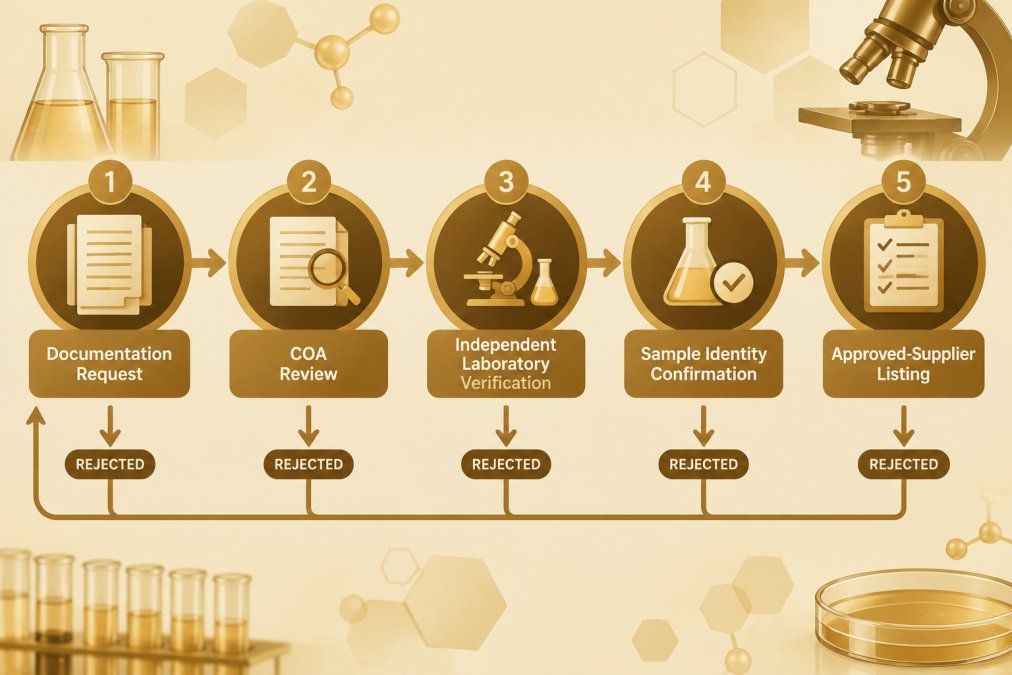
Documentation, Identity, and Traceability Requirements
Three documents anchor a supplier file. The Certificate of Analysis is the batch-specific analytical record stating identity, purity, and method. The specification sheet states what the material is claimed to be, including salt form and quantity. The chain-of-custody record traces the lot from synthesis or acquisition through shipping to receipt. A supplier that cannot produce all three for a specific lot is not a qualified supplier, regardless of catalog presentation.
What a Research Peptide Certificate of Analysis Must Contain
A research peptide Certificate of Analysis must state the compound name, the lot or batch number, the testing laboratory, the analytical methods used, the purity result with the method it was obtained by, and the identity confirmation result. Anything less is a marketing document rather than an analytical one.
The common failure is a COA with no lot number. A purity figure unattached to a batch cannot be verified against the vial in hand. A second failure is a COA issued by the supplier’s own quality unit with no independent laboratory named. For a full walkthrough of each field, see how to read a certificate of analysis.
| COA Field | What It Establishes | Red Flag If Absent |
|---|---|---|
| Compound name and salt form | Compound identity | Name only, no salt specified |
| Lot or batch number | Traceability to the vial | No lot reference |
| Testing laboratory | Independence of analysis | Supplier’s own letterhead only |
| HPLC method and purity result | Purity verification | Purity stated without method |
| Mass spectrometry result | Identity confirmation | No mass data reported |
| Storage and shipping conditions | Handling integrity | No conditions stated |
How to Verify Peptide Purity Beyond the Summary Page
Verifying peptide purity means reading the underlying chromatogram and spectrum rather than the summary line. A reported purity figure is a conclusion; the chromatogram is the evidence for it.
Request the raw data. Laboratories performing in-house molecular identity testing generally want the chromatography files, not a rendered summary, so that integration parameters and peak assignment can be checked independently. Suppliers that release only a summary page are asking for trust in place of documentation.
Reading HPLC Chromatograms and Mass Spectrometry Data
In HPLC, purity is derived from the relative area of the principal peak against total integrated peak area. What matters is the integration method, the wavelength used for detection, and whether minor peaks were included or excluded from the calculation. A chromatogram that reports a single peak with no baseline detail is not informative. Mass spectrometry supplies the orthogonal check: the observed mass-to-charge ratio should correspond to the expected molecular ion for the stated structure and salt form. A step-by-step treatment of trace interpretation appears in this guide to reading HPLC chromatograms.
Third-Party Peptide Testing and Laboratory Verification
Third-party peptide testing is meaningful only when the laboratory is identifiable, independent of the supplier’s commercial interest, and verifiable against public records. A logo on a PDF is not verification.
Verification proceeds in four steps. First, confirm the laboratory’s legal name and location from the COA, not from the supplier’s website. Second, check whether the laboratory appears in a public accreditation directory for the methods used, for example, ISO/IEC 17025 accreditation listings maintained by recognized accrediting bodies, and note the scope of accreditation, since many laboratories are accredited for some methods but not for the specific HPLC or mass spectrometry methods reported. Third, request the laboratory’s raw data package (chromatograms, spectra, integration parameters) and confirm that the file metadata, instrument, acquisition date, operator, is consistent with the lot date. Fourth, ask the supplier to authorize direct contact with the laboratory for confirmation of the report; a supplier that declines has not provided third-party testing in any auditable sense.
A common pattern is a COA issued by a laboratory that shares ownership or address with the supplier. Independence is a structural property, not a statement. Where the laboratory and supplier are related entities, the analysis is effectively in-house and should be treated as such in the supplier file.
Watch out: a laboratory name that cannot be matched to a public accreditation record, or a report whose method falls outside the laboratory’s accredited scope, is a documentation defect even when the purity figure is high.
For a step-by-step treatment of trace interpretation and method assessment, see this guide to reading HPLC chromatograms and this explanation of independent third-party laboratory testing.
Batch Traceability and Lot-Specific Documentation
Traceability is the property that lets a laboratory answer, months later, exactly which analytical record corresponds to which vial. It requires that the lot number on the COA match the lot number on the label, the packing slip, and the receiving log.
Watch out: the most common traceability break is a supplier that reuses a single COA across multiple production runs. If the same document accompanies successive orders with different dates, the document is not batch-specific. Batch-level COAs, HPLC purity results, and mass spectrometry records can be reviewed directly through the certificates of analysis archive.
Risk-Based Supplier Monitoring and Procurement Trade-Offs
Supplier approval is not a one-time event. A risk-based monitoring schedule assigns review frequency according to the criticality of the compound and the supplier’s documentation history, with tighter review for materials central to active studies.
Change control is the mechanism that catches silent substitutions. Any change to the synthesis route, the testing laboratory, the specification sheet, or the packaging configuration should trigger a documented re-qualification before the next lot is accepted.
Incoming inspection connects monitoring to the physical material.
Procurement trade-offs are real. Pricing depends on quantity, lot size, and delivery terms, and a lower unit cost can reflect a thinner documentation package.
Watch out: a supplier that cannot provide a written corrective-action response to a documentation discrepancy is a supplier whose monitoring program cannot close the loop.
Receiving, Storage, and Chain-of-Custody Procedures
Receiving is where documentation meets physical material. The procedure should be fixed before the first shipment arrives.
- Confirm the lot number on the label matches the COA and packing slip
- Record the receiving date, condition, and any temperature indicator reading
- Photograph packaging and label before opening
- Log storage location and conditions against the specification sheet
- File the COA against the internal lot record
- Quarantine any lot with a documentation discrepancy pending supplier response
Cold chain and storage conditions stated on the specification sheet should be verified on arrival, not assumed. A lot that arrives outside its stated conditions should be treated as undocumented until the supplier provides a written position.
Initiating a Qualified Supplier Review with APEX 100 RESEARCH
A supplier review begins with a documentation request, not an order. Laboratories should ask for a sample COA from a recent lot, the identity of the testing laboratory, and confirmation that raw analytical data can be released.
A batch-specific Certificate of Analysis is a document that a supplier file should expect with every order. Questions about compound specifications, COAs, orders, or shipping can be directed through the contact page to begin a supplier review.
Qualifying a supplier is slower than ordering from one. The documentation burden sits with the supplier, and a laboratory that insists on lot-specific records, identifiable independent testing, and retrievable raw data will find that most of the qualification work has already been done for it.
For research use only, not only —. Not medical advice.
Frequently Asked Questions
How can researchers evaluate a research compound supplier?
Evaluation rests on documentation rather than reputation. A laboratory should request a batch-specific Certificate of Analysis, confirm the testing laboratory is independent and identifiable, check that the COA states a testing method and analytical results, and verify that the lot number on the document matches the lot number on the shipment. Researchers writing in PLOS Computational Biology (Schwab et al., 2022) describe structured artifact organization as a way to make data reusable within and outside a laboratory, and the same principle applies to procurement records: a supplier whose documentation can be filed, cross-referenced, and audited is easier to qualify than one that supplies summaries alone.
What should a Certificate of Analysis include?
A research peptide Certificate of Analysis should identify the compound by name and specification, state the lot or batch number, name the testing laboratory, describe the testing method used for each assay, and report the analytical results against a stated acceptance criterion. Purity by HPLC, identity confirmation by mass spectrometry, and the salt form are the core entries. Appearance, packaging, and storage conditions are useful additions. A COA that reports a purity figure without naming the method or the laboratory gives a reviewer nothing to verify, and that gap is a legitimate reason to request additional documentation before ordering.
How can a lab verify a compound’s purity and identity independently?
Independent verification means testing the received material rather than trusting the supplier’s summary. In-house molecular identity testing by mass spectrometry, paired with HPLC purity determination against a qualified reference, gives the laboratory its own analytical record. Where in-house capacity is limited, an accredited contract laboratory can perform the same assays. Comparing the in-house result against the supplier’s COA for the same lot number is the actual verification step. Discrepancies between the two sets of analytical results should be documented and raised with the supplier before the material enters inventory.
Why is batch traceability important when sourcing research compounds?
Traceability connects a specific container of material to a specific analytical record. If a study produces an unexpected result, the laboratory needs to know which lot was used, when it was received, how it was stored, and what the COA for that lot reported. Without lot-specific documentation, a researcher cannot distinguish a compound problem from a handling problem. Chain-of-custody records, receiving logs, and storage condition records complete the chain. Suppliers that issue a fresh COA for every batch make this straightforward; suppliers that reuse a single COA across multiple lots break the chain at the first link.
What questions should a lab ask before placing a research compound order?
Ask which independent laboratory performs the testing and whether it can be contacted directly. Ask whether raw chromatography and spectroscopy files are available alongside the COA summary. Ask what happens if a received batch fails the stated purity specification, and how a replacement is handled. Ask whether minimum order quantities apply and how pricing scales with committed volume. Ask where the material is sourced and whether regulatory documentation would support a future investigational filing. The answers separate suppliers that can support an audit trail from those that can only supply a product.
How should researchers compare peptide suppliers on cost?
Comparison on unit price alone misses the cost of a failed batch. A procurement decision should weigh the price per unit against the documentation provided, the availability of independent testing records, replacement terms if a batch fails specification, and the staff time spent chasing missing paperwork. A supplier that requires repeated follow-up for COAs and lot records carries an administrative cost that does not appear on the invoice. Laboratories running repeat studies should model total cost across a year of orders rather than evaluating a single purchase in isolation.