How Researchers Access Raw Peptide Chromatography Data
Last Updated: November 4, 2026
Quick Summary
Raw peptide chromatography data access starts with retrieving unprocessed instrument files, total ion current, extracted ion chromatograms, precursor m/z values, retention times, and fragmentation spectra, from public repositories such as ProteomeXchange, PeptideAtlas, and MassIVE. Researchers search by accession (PXD, MSV, or PASS), confirm the metadata record lists raw files rather than search results alone, then download and verify each file against its deposited checksum before conversion to mzML, mzXML, or MGF.
- Raw files hold unprocessed detector signal in vendor-specific binary formats, before any database search or quantification.
- The MassIVE interface at UCSD provides access to over 300 million peptide-spectrum matches.
- Accession lookup is deterministic; keyword searches by organism and instrument return noisy results.
- A checksum mismatch indicates a truncated or corrupted transfer and warrants re-download.
- A 1% FDR at the peptide-spectrum match level is the common convention, but the FDR method should be recorded.
Table of Contents
- What Raw Peptide Chromatography Data Actually Contains
- Locating Raw Files in Mass Spectrometry Data Repositories
- Step by Step: Downloading and Validating a Raw Dataset
- DIA and DDA Workflows for Peptide Identification
- Software for Inspecting Chromatograms and Spectra After Download
- Provenance, Licensing, and Reuse Requirements
- Independent Lab Testing for Peptides and What It Verifies
- Interpreting Certificate of Analysis for Peptides Alongside Raw Data
- Frequently Asked Questions
What Raw Peptide Chromatography Data Actually Contains
Raw peptide chromatography data access begins with a file, not a figure. Researchers describe this as the substrate layer of proteomics.
The distinction matters because processed output and raw output answer different questions. A peptide-spectrum match table reports what software concluded; a raw file records what the instrument measured. As the NCBI review of data-independent acquisition in proteomics notes, acquisition strategy shapes reproducibility and throughput long before statistical filtering begins.
Signal extraction is the first interpretive hurdle. Raw spectra carry substantial noise, and the literature documents that conversion into denoised, centroid formats is a prerequisite for accurate analysis (Li et al., 2005).
Locating Raw Files in Mass Spectrometry Data Repositories
Mass spectrometry data repositories are public archives that store raw instrument files, search results, and spectral libraries alongside metadata describing acquisition parameters. ProteomeXchange-coordinated resources, PeptideAtlas, and MassIVE form the core infrastructure, and scale is considerable: the MassIVE interface at UCSD provides access to over 300 million peptide-spectrum matches.
Repositories differ in what they hold and what they permit.
| Repository type | Typical contents | Access model |
|---|---|---|
| Raw file archives | Vendor .raw.d.wiff files | Open or credentialed download |
| Spectral libraries | Annotated spectra, assay libraries | Open download, format-dependent |
| Search result stores | Peptide-spectrum matches, protein identifications | Open browsing |
| Chromatogram libraries | Fragment ion chromatograms for DIA | Often build-dependent |
The practical constraint is not discovery but completeness. A dataset entry may list raw files while withholding them pending publication, or may deposit only search results. Reading the access conditions before planning a reanalysis saves considerable time.
Step by Step: Downloading and Validating a Raw Dataset
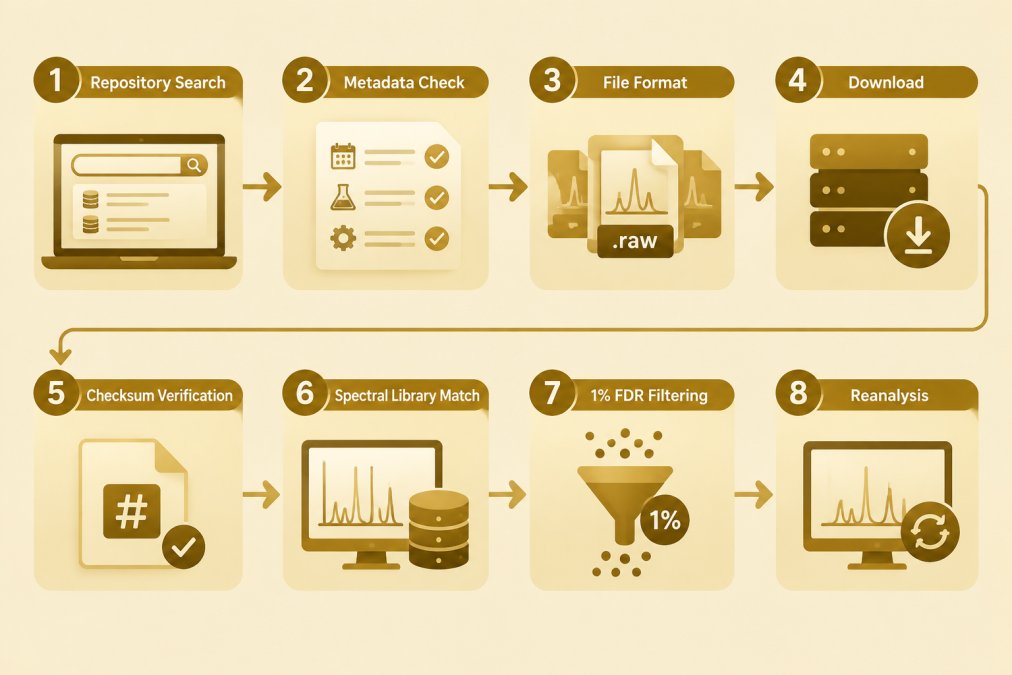
Most repository guides stop at “find the dataset and download it.” The practical work, and the part reviewers question, is verification. The sequence below consolidates search, access, download, and validation into a reproducible workflow that can be documented alongside any reanalysis.
- Search by accession, not by keyword alone. ProteomeXchange datasets carry a PXD identifier; MassIVE uses MSV; PeptideAtlas uses PASS. Keyword searches by organism and instrument return noisy results, while accession lookup is deterministic. Where the accession is unknown, filter by instrument model, acquisition mode (DDA or DIA), and species before opening any record.
- Read the metadata record before committing to a download. Confirm instrument model, fragmentation method (HCD, CID, ETD), collision energy, and whether the deposit is DDA or DIA. A record that lists only search results, no raw files, cannot support independent reprocessing.
- Check the file format against available conversion tools. Thermo .raw, Bruker .d, and Sciex .wiff each require different converters. Confirm the format is supported by the toolchain before downloading tens of gigabytes.
- Download raw files and any accompanying search results together. Search results deposited alongside raw files provide a baseline against which a fresh database search can be compared.
- Verify file integrity against the deposited checksum. Most repositories publish an MD5 or SHA-1 checksum per file. A mismatch indicates a truncated or corrupted transfer and warrants a re-download before any analysis begins.
- Convert to an open format and confirm spectrum counts. Conversion to mzML, mzXML, or MGF should preserve MS1 and MS2 scan counts; a large discrepancy between the vendor file and the converted file signals a conversion error.
- Match against a spectral library or run a database search. Library matching is appropriate for DIA data with a matched assay library; database search is appropriate for DDA and for DIA without a library.
- Filter at a stated false discovery rate. A 1% FDR at the peptide-spectrum match level is the common convention, but the FDR method (target-decoy, percolator, picked-protein) should be recorded because results are not directly comparable across methods.
Watch out: A dataset that downloads cleanly and converts without error can still be unusable for reanalysis if the deposited metadata omits the fragmentation method or collision energy, those parameters cannot be recovered from the raw file alone and must be requested from the submitting laboratory.
Checking Metadata and File Formats Before Download
File format determines everything downstream. Thermo .raw, Bruker .d, and Sciex .wiff require different conversion paths, and some open tools accept only centroided data, profile-mode spectra must be centroided before search. Metadata should also confirm whether the deposit is DDA or DIA, since the two demand different analysis software and different library strategies. A common pattern in public deposits is that the raw files are complete but the metadata record is thin: instrument model and species are present, while collision energy, gradient length, and column dimensions are missing. Those omissions do not prevent conversion but do limit how faithfully a reanalysis can reproduce the original result. For readers cross-checking purity claims against instrument output, how HPLC and MS results verify peptide purity covers the analytical logic in more detail.
DIA and DDA Workflows for Peptide Identification
Acquisition mode dictates the analysis route. Data-dependent acquisition selects precursor ions for fragmentation in real time, producing clean tandem mass spectra for the most abundant species and missing lower-abundance peptides. Data-independent acquisition fragments all precursors within defined m/z windows, generating complex, multiplexed spectra that require library-based deconvolution but deliver more consistent coverage across samples.
The trade-off is well documented. DIA improves reproducibility and throughput relative to traditional approaches, according to the NCBI proteomics review, while DDA remains simpler to interpret and better supported by legacy search engines. Chromatogram libraries built from DIA runs now function as reusable reference assets for subsequent experiments.
Peptide identification in either mode terminates in a peptide-spectrum match scored against a database, then filtered.
Software for Inspecting Chromatograms and Spectra After Download
Inspection software falls into three categories, and choosing correctly depends on whether the goal is viewing, converting, or reanalyzing.
- Viewers: display total ion chromatograms, extracted ion chromatograms, and annotated spectra for manual review
- Converters: translate vendor formats into open mzXML or MGF representations suitable for downstream tools
- Search engines and pipelines: perform database search, library matching, and FDR estimation
For step-by-step guidance on reading the traces themselves, how to read a peptide HPLC chromatogram walks through the interpretation sequence.
What most guides miss is that visualization is not validation. A clean-looking chromatogram confirms the detector behaved plausibly; it does not confirm the identification. Those are separate checks.
Provenance, Licensing, and Reuse Requirements
Provenance is the record of where a dataset came from, who generated it, and what transformations it has undergone. Licensing determines whether it can be redistributed or used commercially.
Provenance in practice means being able to trace a raw file back to its publication. Most ProteomeXchange-coordinated deposits link a PXD accession to a PubMed identifier, and that link is the anchor for attribution.
Licensing is less standardized than the infrastructure suggests. Three license patterns appear in public proteomics deposits:
- Creative Commons Attribution (CC BY): permits reuse and redistribution with attribution, including commercial use in some deposits.
- Creative Commons Attribution-NonCommercial (CC BY-NC): permits academic reuse but restricts commercial application; the boundary between research and commercial use is frequently ambiguous.
- No explicit license, publication reference only: the most common pattern, and the most ambiguous, reuse terms default to the publication’s copyright and the submitter’s implied consent, which is not a formal license.
Three questions resolve most reuse ambiguity:
- Does the deposit include a license statement, or only a publication reference?
- Are raw files covered by the same terms as the search results, or do the two carry different conditions?
- Does reanalysis require re-depositing derived data, and if so, under what accession?
A practical pattern is to record the license, the accession, and the publication identifier together in the methods section of any derived work, which makes the provenance chain auditable.
The same logic applies to dataset reuse: a dataset without a license statement is one whose reuse terms are unknown rather than permissive.
Independent Lab Testing for Peptides and What It Verifies
Independent lab testing for peptides is third-party analytical verification of identity and purity, performed outside the supplying organization and reported against a specific batch. It typically combines HPLC for purity assessment with mass spectrometry for molecular identity confirmation.
What it verifies is narrower than buyers assume. Testing confirms that the material in the vial matches the expected molecular mass and that chromatographic purity meets a stated threshold. It does not confirm biological activity, sterility, or suitability for any application. Those are separate determinations outside the analytical scope.
APEX 100 RESEARCH states that it sources materials in the USA and verifies batches through independent third-party laboratories in California, with a batch-specific Certificate of Analysis reporting ?99% HPLC purity and molecular identity. For a broader treatment of what such testing does and does not establish, the guide to independent lab testing for peptides examines the methodology.
Interpreting Certificate of Analysis for Peptides Alongside Raw Data
A certificate of analysis is a batch-specific document reporting the analytical methods applied to a lot and the results obtained, including purity figures, identity confirmation, and the testing laboratory. Read alone, it is a summary. Read against raw chromatography data, it becomes verifiable.
The pairing matters for laboratory managers performing in-house identity testing. A certificate states a purity percentage; the chromatogram shows the peak profile that produced it. Discrepancies between the two, unusual integration, or missing method detail are legitimate grounds for requesting the underlying files.
For readers who want the full interpretation framework, the 2026 guide to reading a certificate of analysis covers each field in sequence. Batch-level records, including HPLC purity results and mass spectrometry identity checks, are available through the certificate of analysis records maintained for each lot.
Access to raw peptide chromatography data is a documentation problem more than a technical one: the files exist, the repositories are public, and the conversion tools are open, but the chain from instrument to published claim is only as strong as its metadata.
For research use only, not only —. Not medical advice.
Frequently Asked Questions
Where can researchers access raw peptide chromatography data?
Raw files are distributed through public proteomics repositories and, for purchased compounds, directly from the supplier. MassIVE at UCSD is one of several public repositories offering access to peptide-spectrum match data, and PeptideAtlas is another. For vendor data, researchers should request batch-specific files rather than summary tables. Access conditions, metadata depth, and permitted reuse differ by repository, so the license should be read before any reanalysis is published.
How do I verify peptide batch consistency using raw data?
Batch consistency is assessed by comparing chromatographic profiles across lots under identical method conditions. Researchers examine retention time, peak shape, integration boundaries, and system suitability checks, then align these observations with the batch-specific Certificate of Analysis. Raw files, not summary purity figures, allow this comparison to be repeated independently.
What software is required to analyze raw mass spectrometry files?
Analysis typically requires conversion tools, a database search engine, and a viewer for chromatograms and spectra. Raw LC-MS spectra contain substantial noise, and Raw spectra generally require conversion and denoising into centroid formats before accurate interpretation, and the choice of acquisition approach affects reproducibility and throughput. The specific toolchain depends on instrument vendor and acquisition mode.
Can a supplier provide raw chromatography files with the Certificate of Analysis?
The Certificate of Analysis is a summary document, and raw files are a separate request. Laboratories performing in-house molecular identity testing should ask suppliers whether batch-specific chromatography and spectroscopy files are available and in which format. APEX 100 RESEARCH verifies every batch through independent third-party laboratories in California and includes a batch-specific COA confirming ?99% HPLC purity and molecular identity; raw data requests should be directed to the supplier before ordering. Availability varies by provider and should be confirmed in writing.