Peptide Quality Guarantee for Labs: How to Verify It
Last Updated: November 2, 2026
Quick Summary
A peptide quality guarantee for labs is a documented commitment that a supplied batch meets stated specifications for purity, identity, and testing method, backed by a batch-specific Certificate of Analysis (COA) that a laboratory can independently check. The guarantee is only as strong as the paperwork behind it, so a COA must name the batch, the analytical method, and the result measured against a stated specification.
- A COA without a batch number is a template, not a record.
- HPLC purity measures relative chromatographic purity, not identity, potency, or sterility.
- Mass spectrometry confirms identity by comparing observed mass against theoretical mass.
- Match the batch number on the COA to the vial label, packing slip, and order record.
- A purity percentage does not establish sequence, potency, sterility, or stability over time.
Table of Contents
- What a Peptide Quality Guarantee Actually Covers
- Reading a Peptide Certificate of Analysis Line by Line
- Peptide Purity Testing: What HPLC Reports and What It Misses
- Peptide Identity Verification With Mass Spectrometry
- How to Vet Peptide Suppliers Against Their Own Paperwork
- Sampling, Chain of Custody, and Report-to-Batch Traceability
- What Purity Testing Does Not Establish
- Requesting Documentation for Your Research Program
- Frequently Asked Questions
What a Peptide Quality Guarantee Actually Covers
A peptide quality guarantee for labs is a documented commitment that a supplied batch meets stated specifications for purity, identity, and testing method, backed by a batch-specific Certificate of Analysis (COA) that a laboratory can independently check.
Suppliers vary widely in what they actually promise. According to a 2025 review of regulatory guidance for peptide and protein drug analysis, quality control for peptide materials rests on defined analytical methods and documented specifications, not on marketing claims.
The Four Claims Behind Every Guarantee
- Purity: a percentage, tied to a named method such as HPLC
- Identity: confirmation that the material is the stated sequence, usually by mass spectrometry
- Method: the analytical technique used to produce the result
A guarantee covering purity but not identity is incomplete, and a COA reporting a result without naming the method cannot be checked.
Reading a Peptide Certificate of Analysis Line by Line
A peptide Certificate of Analysis is a batch-specific analytical report listing the tests performed, methods used, results obtained, and the specification each result is measured against. Three fields matter first.
Batch Number, Method, and Result: The Three Fields That Matter
Start with the batch number. It must match the vial, the packing slip, and the order record.
Next, the method. “Purity: 99.2%” means little until the technique is named.
Then the result, read against a stated specification. A number without a threshold is not a pass or fail.
A COA listing a purity figure but omitting the method and specification gives a reader nothing to verify.
For a worked example of how these fields appear on a real batch record, review batch-specific COAs, HPLC purity results, and mass spec identity checks. For a deeper walkthrough of each field and how to interpret it, the guide on how to read a Certificate of Analysis covers the same ground in more detail.
Peptide Purity Testing: What HPLC Reports and What It Misses
HPLC reports the proportion of UV-absorbing material that elutes as the main peak, expressed as a percentage of total peak area.
The technique separates components and detects them, typically at a set wavelength.
Two limits deserve attention: impurities that do not absorb at the detection wavelength can be undercounted, and co-eluting compounds with similar retention behavior can inflate the main peak. Purity percentage is a useful screen, not a complete characterization.
Purity thresholds vary by source.
For a step-by-step walkthrough of the chromatogram itself, the guide on how to read a peptide HPLC chromatogram explains peak integration and baseline interpretation.
Peptide Identity Verification With Mass Spectrometry
Mass spectrometry confirms molecular identity by measuring the mass-to-charge ratio of the analyte and comparing the observed mass against the theoretical mass of the expected sequence.
The technique answers a different question than HPLC. HPLC asks how much of the detected material behaves as one species.
Analytical service providers describe using multiple methods together for peptide characterization.
The article on how to confirm peptide molecular identity in the lab expands on matching observed and theoretical masses and on the limits of a single mass measurement.
How to Vet Peptide Suppliers Against Their Own Paperwork
Supplier vetting is the practice of testing a vendor’s documentation against its own claims before ordering.
A common mistake is accepting a COA at face value because it looks detailed. Detail is easy to format. What matters is whether the document can be checked against an independent record and whether the supplier will let a laboratory confirm it directly.
Independent verification is a live concern, and the habit it calls for is to verify rather than assume.
A Step-by-Step COA Verification Workflow
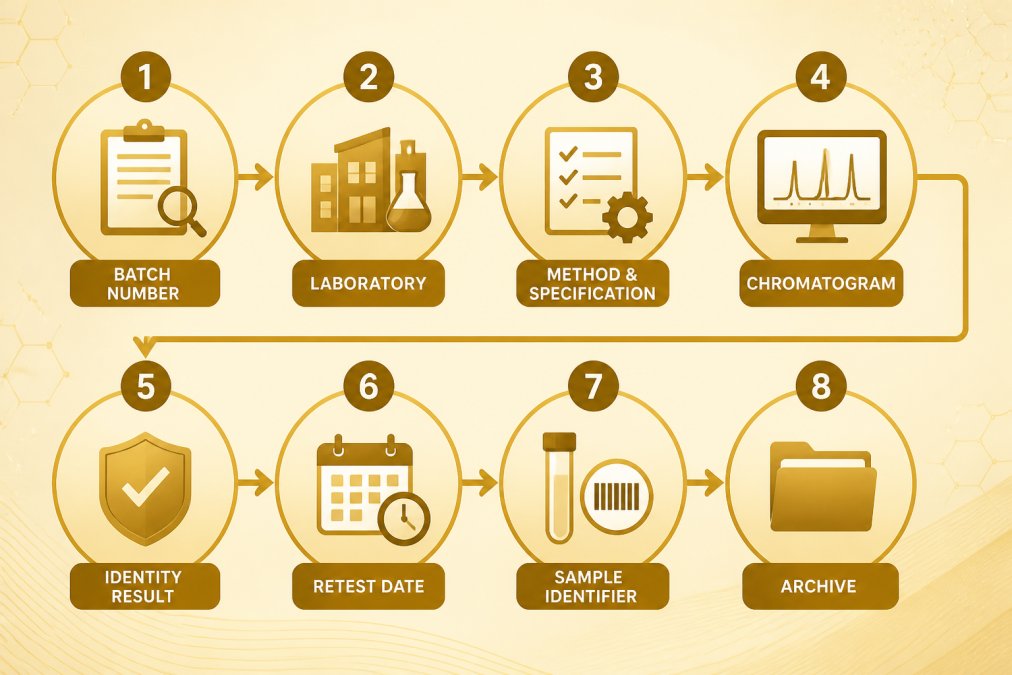
Use this sequence for each incoming batch; a laboratory technician can complete it without contacting the supplier, and a second reviewer can reproduce the conclusion from the same records.
- Match the batch number on the COA to the vial label, the packing slip, and the order record. A mismatch at this step stops the workflow.
- Confirm the testing laboratory is named and independent of the supplier. If the laboratory is a supplier affiliate, note that in the batch record.
- Check that each test lists the analytical method used, HPLC, mass spectrometry, or another technique, and the specification the result is measured against.
- Review the chromatogram for the main peak, the reported impurity peaks, and the integration baseline. A purity figure without an accompanying chromatogram cannot be independently reviewed.
- Compare the mass spectrometry result against the theoretical mass of the expected sequence and confirm the stated tolerance.
- Check the retest or expiry date against the storage conditions stated on the COA and the shipping documentation.
- Confirm the report carries a sample identifier, not only a batch number, so the tested aliquot can be tied to the batch.
- Archive the COA, the receiving date, and the storage conditions together in the batch record for later traceability.
A Vendor-Neutral Decision Matrix for Laboratory Buyers
Most visible guidance in this market is vendor- or service-oriented. A neutral framework scores suppliers on documentation criteria that any laboratory can apply consistently.
| Criterion | What to request | Why it matters |
|---|---|---|
| Batch-specific COA | A COA naming the batch, the sample identifier, and the analysis date | A COA without a batch link is a template, not a record |
| Method disclosure | The analytical method named for each test | A result without a method cannot be checked or reproduced |
| Independent laboratory | The name of the testing laboratory and its relationship to the supplier | Independence is what makes the result checkable |
| Identity confirmation | A mass spectrometry result compared against theoretical mass | Purity alone does not confirm the sequence |
| Traceability | Sample identifier, chain-of-custody record, and receiving date | A test is only useful if the sample represents the purchased batch |
| Out-of-specification policy | A written policy for failed batches and replacement handling | A guarantee without a remedy is a statement, not a commitment |
| Stability and retest data | Retest triggers and storage conditions supported by data | A one-time purity result does not describe behavior over time |
A supplier that cannot answer these criteria in writing before an order is telling the buyer something useful.
A reader who wants to see how one supplier documents independent testing and batch certificates can review the testing standards described by Apex 100 Research.
Sampling, Chain of Custody, and Report-to-Batch Traceability
Traceability is the ability to link a specific test result back to a specific unit of material through an unbroken record. Without it, a COA describes a batch in general but not the vial in hand, a report may name a batch but rarely shows how the tested sample was selected, handled, or tied to the purchased unit.
Sampling: Making the Tested Aliquot Represent the Batch
A test is only useful if the tested sample represents the purchased batch. Sampling should follow a defined procedure so the aliquot is not biased toward the top of a container, a single vial, or a portion handled differently from the rest.
Common patterns in laboratory practice include:
- A written sampling plan that states how many units are sampled and how the aliquot is drawn
- A sample identifier assigned at the time of sampling, recorded separately from the batch number
- A record of the sampling date, the sampler, and the storage conditions at the time of sampling
Small lapses break the chain. A COA naming a batch but not a sample identifier cannot be tied to a specific aliquot; a report with no analysis date cannot be placed in sequence with a retest schedule.
Chain of Custody: Documenting Who Handled the Sample
Chain of custody is the record of who handled the sample, when, and under what conditions, from sampling through analysis, the part of traceability most supplier documentation omits, and the part that makes a result defensible if a batch is later questioned.
A chain-of-custody record typically carries:
- The sample identifier and the batch number it was drawn from
- The name and role of each handler and the date of each transfer
- The storage conditions during each leg of the transfer
For a laboratory running repeated studies, the batch record should hold the COA, chain-of-custody record, receiving date, and storage conditions together, the file that makes later batch comparisons meaningful.
Report-to-Batch Traceability: Closing the Loop
The report should carry the batch number, sample identifier, and date of analysis, and those fields should match the chain-of-custody record and receiving documentation. When the three records agree, a laboratory can state with confidence that the result describes the material in hand; when they do not, the result describes a batch in general, a weaker claim than a quality guarantee implies.
A quality guarantee is only as strong as the traceability behind it. Sampling procedure, chain-of-custody documentation, and report-to-batch matching are what turn a COA from a general batch description into a record of the specific material a laboratory received.
What Purity Testing Does Not Establish
A purity result alone does not establish every aspect of peptide quality. This is the point most supplier documentation glosses over.
Quality control guidance for peptide drug release, as summarised in provider literature, lists identity, purity, potency, and sterility testing alongside stability studies.
What a purity percentage does not tell a reader:
- Whether the material is the correct sequence, which requires identity testing
- How much biological or chemical activity the material retains, which requires a potency assay
- Whether the material is sterile or free of microbial contamination
A guarantee built only on an HPLC percentage is a partial guarantee. Researchers should ask what else was tested and what was not.
Requesting Documentation for Your Research Program
Documentation requests should be specific and made before the order, not after.
Ask for the batch-specific COA in advance, with the method named for each test. Ask whether testing is performed by an independent laboratory and whether that laboratory can be named.
For programs that may later require regulatory documentation, ask early how the supplier’s records would support that work.
A practical checklist for the request:
- Batch-specific COA with method named per test
- Identity result by mass spectrometry
- Name of the independent testing laboratory
The gap between a stated guarantee and a verified one comes down to documentation a laboratory can check. Researchers can review the research compound catalog to see current offerings and request batch documentation before ordering.
For research use only, not only —. Not medical advice.
Frequently Asked Questions
What should a peptide Certificate of Analysis include?
A usable peptide Certificate of Analysis should identify the batch number, the material name and sequence, the analytical methods used, the results for each method, and the date of analysis. Elsayed et al. (2025) describe regulatory guidance for analysis and quality control of peptide and protein drugs, which treats method disclosure and result reporting as core documentation. GenScript notes that release testing for peptide drugs covers identity, purity, potency, and sterility, plus stability studies supporting shelf life. Research-grade COAs typically report a narrower set, so researchers should confirm which fields are present before relying on the document.
How can a lab verify peptide purity and identity?
Purity and identity are separate measurements and need separate methods. HPLC is used to resolve and quantify impurities, producing a chromatogram and a purity percentage. Mass spectrometry confirms molecular identity by matching observed mass to the expected mass of the peptide sequence. BioPharmaSpec lists mass spectrometry, NMR, and HPLC among the analytical methods used for peptide characterization. A peptide quality guarantee that reports only a purity percentage leaves identity unaddressed, so labs should request both results and check that each is tied to the same batch number.
What does HPLC purity tell researchers about a peptide?
HPLC purity reports the proportion of UV-absorbing material that elutes as the main peak under one set of chromatographic conditions. It does not identify what that peak is, and it does not detect impurities that fail to absorb at the detection wavelength or that co-elute with the main peak. Suppliers cite differing thresholds: one guide states research peptides usually need greater than 90% purity, while another states most research applications require greater than 98% by HPLC, with some complex peptides acceptable above 95%. The sources do not establish a single consensus standard, so the number should be read alongside method details and identity data.
Why should peptide testing be batch-specific?
A certificate tied to a batch number can be checked against the vial actually received; a generic or representative COA cannot. Batch-specific testing is the only way to confirm that the material in hand was the material analyzed. Independent testing is sometimes found to reveal discrepancies between supplier certificates and measured results, and the underlying data behind such claims is not always identified. Regardless of how often this occurs, the practical control is the same: match the batch number on the vial to the batch number on the report.