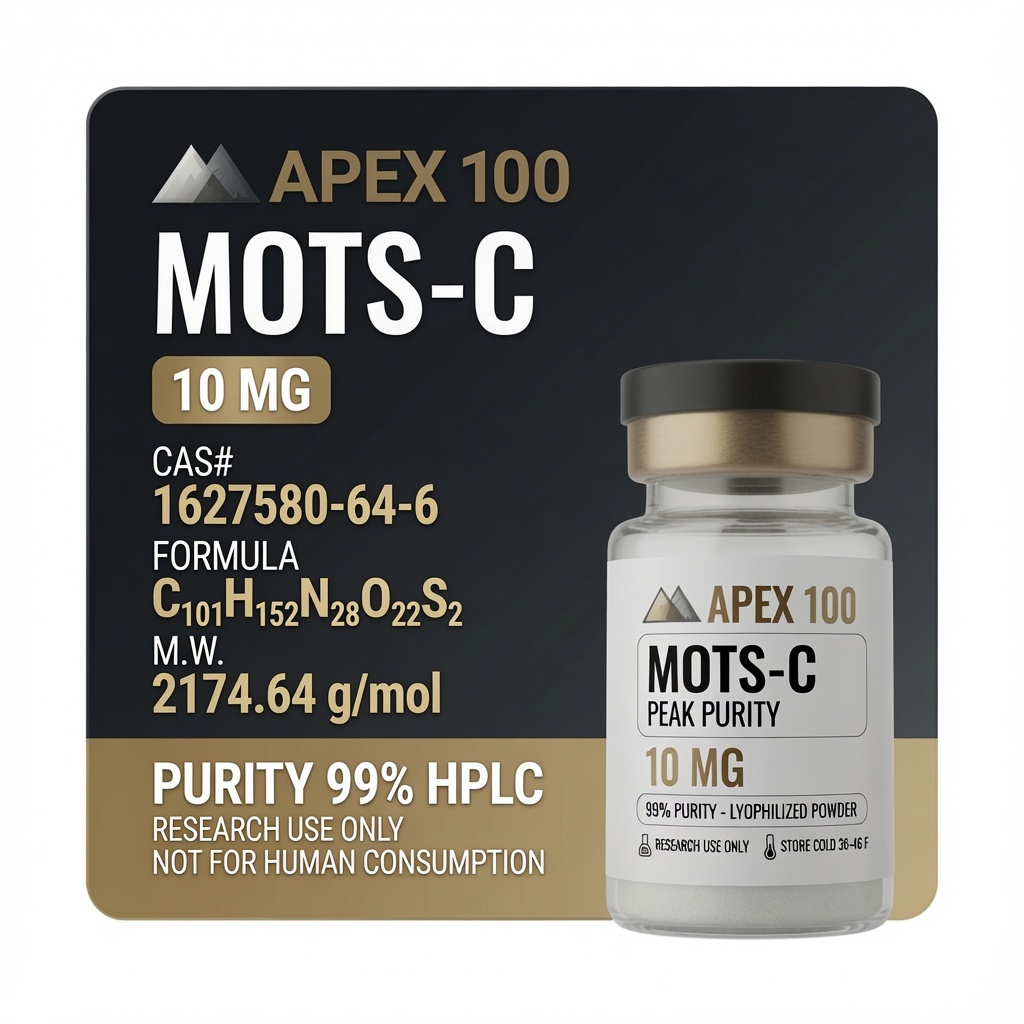
999 in stock
Download Certificate of Analysis (PDF)For research and laboratory use only — Not for human consumption
MOTS-C occupies a unique position in peptide research: it is encoded not within nuclear DNA, but within the mitochondrial 12S rRNA gene—making it the first peptide of mitochondrial origin demonstrated to exert systemic regulatory effects at a distance from its site of synthesis. Its discovery in 2015 by Lee and colleagues at USC opened a new category of signaling molecules now termed mitochondria-derived peptides (MDPs).
This 16-amino acid peptide (C₁₀₁H₁₅₂N₂₈O₂₅S₂) operates primarily through AMPK pathway activation, but the upstream mechanism is more nuanced: MOTS-C enters the nucleus under metabolic stress conditions and directly regulates nuclear gene expression, including genes in the folate-methionine cycle. This nucleus-entry behavior makes MOTS-C mechanistically distinct from most exercise-related peptides studied to date.
Published research has documented serum MOTS-C levels declining with age in both animal and human cohorts, and preclinical application studies have demonstrated effects on insulin sensitivity, physical endurance, and metabolic flexibility. For researchers working in longevity biology, mitochondrial signaling, or exercise physiology, MOTS-C represents a compound with a well-supported mechanistic rationale. APEX 100 supplies MOTS-C as ≥99% HPLC-verified lyophilized powder with a full COA.
For research and laboratory use only. Not for human consumption.
| CAS Number | 1627580-64-6 |
| Molecular Formula | C₁₀₁H₁₅₂N₂₈O₂₅S₂ |
| Molecular Weight | ~2,174.64 Da |
| Sequence | 16 amino acids |
| Receptor Targets | AMPK Pathway |
| Purity | ≥99% (HPLC) |
| Form | Lyophilized powder |
| Storage | -20°C (lyophilized) |
| Grade | Research Grade |
| Use | For Research Use Only |
<
p style="
This site contains research compounds for laboratory use only.
Enter your email to confirm you are 21+ and agree to our research-use terms.